From Energy Corridors to Chip Diplomacy: PM Modi’s Five-Nation Tour Reshapes India’s Global Ambitions
Ms.Bornali Biswas-Editor in Chief / 29th May 2026

As Prime Minister Narendra Modi returned to New Delhi on May 21 after an intense five-nation diplomatic tour spanning the United Arab Emirates, Netherlands, Sweden, Norway, and Italy, the message from global capitals was unmistakable: India is no longer merely participating in global geopolitics—it is increasingly shaping it.
The high-octane diplomatic sprint produced over 57 strategic agreements and investment commitments across sectors ranging from energy security and semiconductors to green technology, defense manufacturing, maritime cooperation, and climate innovation. More importantly, the tour underscored how India’s foreign policy has evolved from traditional diplomacy into a multidimensional strategy focused on economic resilience, technological sovereignty, and geopolitical influence.
The New Architecture of India’s Global Partnerships
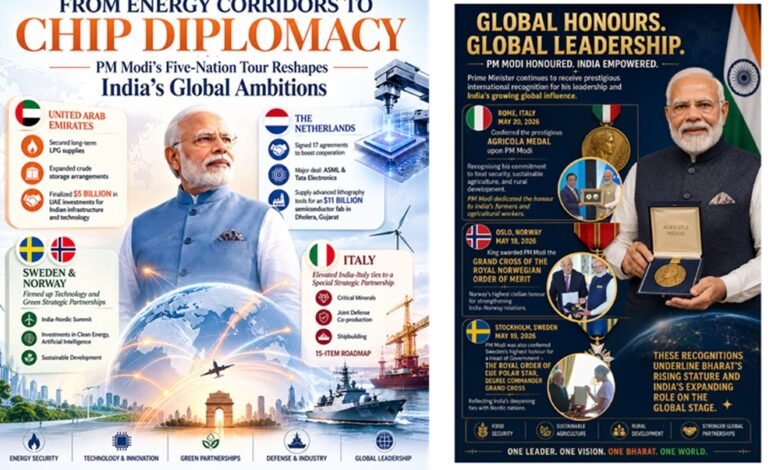
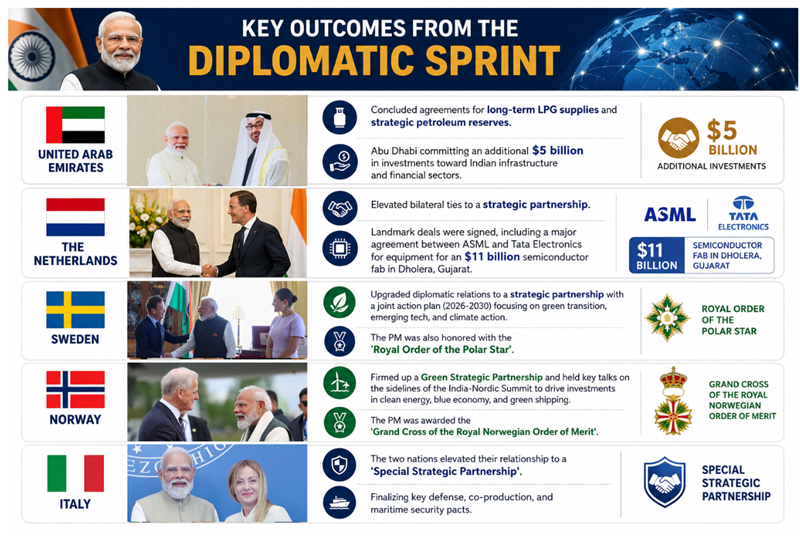
The first stop in the UAE highlighted the deepening economic and strategic trust between New Delhi and Abu Dhabi. Long-term LPG supply agreements and expansion of India’s strategic petroleum reserves signaled India’s determination to secure energy stability amid global uncertainty. The UAE’s additional $5 billion investment commitment in Indian infrastructure and financial sectors further reinforced the Gulf nation’s growing confidence in India’s economic trajectory.
Yet the most consequential outcomes arguably emerged in Europe.
In the Netherlands, India elevated bilateral ties to a strategic partnership with a strong focus on advanced manufacturing and semiconductor collaboration. The landmark ASML-Tata Electronics agreement for equipment supply to the proposed $11 billion semiconductor fabrication plant in Dholera, Gujarat, could become a defining moment in India’s ambition to emerge as a global semiconductor hub.
At a time when chip supply chains are increasingly entangled in geopolitical competition, India’s engagement with Dutch semiconductor giant ASML signals a deliberate effort to reduce technological dependence and build domestic capability in one of the world’s most strategic industries.
Green Diplomacy Becomes Core Strategy
The Nordic leg of the tour reflected another major shift in India’s foreign policy priorities: green diplomacy.
In Sweden, bilateral relations were elevated to a strategic partnership under a Joint Action Plan (2026–2030) focused on clean technology, innovation, climate action, and digital transformation. The conferring of the prestigious “Royal Order of the Polar Star” on PM Modi symbolized not only diplomatic warmth but also recognition of India’s expanding global role.
Similarly, discussions in Norway centered on a Green Strategic Partnership aimed at accelerating collaboration in clean energy, offshore technologies, blue economy initiatives, and green shipping corridors. As the world races toward carbon neutrality, India is positioning itself not merely as a developing economy seeking climate support, but as a key partner in building future green infrastructure.
The India-Nordic Summit meetings further reflected growing alignment between India and Northern European nations on sustainable development, Arctic cooperation, resilient supply chains, and next-generation innovation ecosystems.
Defense and Maritime Cooperation Gain Momentum
The final leg in Italy revealed how strategic and security cooperation is becoming a central pillar of India’s engagement with Europe.
India and Italy upgraded ties to a “Special Strategic Partnership,” announcing agreements on defense co-production, maritime security, and industrial collaboration. With Europe increasingly reassessing its Indo-Pacific strategy, India is emerging as a crucial partner in maintaining maritime stability and securing critical trade routes.
The agreements also fit into India’s broader push for defense self-reliance under the “Make in India” framework, encouraging technology transfer and joint manufacturing with trusted global partners.
India’s Foreign Policy Enters a New Phase
Beyond the investment figures and diplomatic ceremonies, the larger significance of the tour lies in what it reveals about India’s changing global posture.
For decades, Indian diplomacy often centered on balancing global powers while protecting strategic autonomy. Today, that approach is evolving into proactive coalition-building driven by economics, technology, energy security, and strategic partnerships.
From Gulf energy corridors and European semiconductor ecosystems to Nordic green alliances and Mediterranean maritime cooperation, India is building diversified partnerships that reduce vulnerabilities and expand influence.
The awards and honors bestowed upon PM Modi during the tour also reflect India’s rising diplomatic visibility on the global stage. But the true measure of success will depend on how effectively these agreements translate into long-term investments, jobs, technological capacity, and strategic leverage for India.
As geopolitical tensions reshape global supply chains and economic alliances, India appears determined to position itself not on the sidelines, but at the center of the emerging international order.
And this five-nation tour may well be remembered as another significant step in that transformation.
Prime Minister continues to receive prestigious international recognition for his leadership and India’s growing global influence.
In Rome, they conferred the prestigious Agricola Medal upon PM Modi on May 20, 2026, recognising his commitment to food security, sustainable agriculture, and rural development. PM Modi dedicated the honour to India’s farmers and agricultural workers.
On May 18, 2026, King awarded PM Modi the Grand Cross of the Royal Norwegian Order of Merit — Norway’s highest civilian honour — for strengthening India–Norway relations.
Sweden’s highest honour for a Head of Government — the Royal Order of the Polar Star, Degree Commander Grand Cross was awarded to PM Modi — reflecting India’s deepening ties with Nordic nations.
These recognitions underline Bharat’s rising stature and India’s expanding role on the global stage. ✨