Free Bus Travel for Women: Empowerment on Wheels or a Fiscal Challenge?
Ms.Bornali Biswas-Editor in Chief/9th June 2026

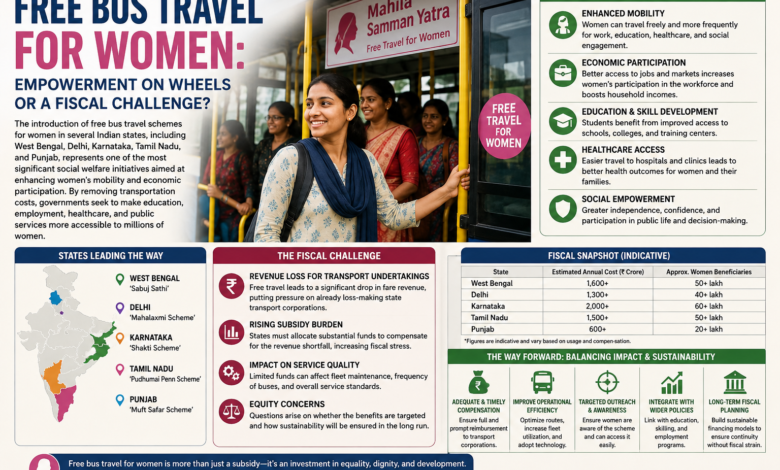
The introduction of free bus travel schemes for women in several Indian states, including West Bengal, Delhi, Karnataka, Tamil Nadu, and Punjab, represents one of the most significant social welfare initiatives aimed at enhancing women’s mobility and economic participation. By removing transportation costs, governments seek to make education, employment, healthcare, and public services more accessible to millions of women.
The benefits of such schemes are substantial. For women from low-income households, daily commuting expenses often consume a significant portion of their earnings. Free travel increases disposable income, encourages women to seek jobs farther from home, and improves access to educational institutions and healthcare facilities. The policy also promotes greater independence and social inclusion, particularly for rural women, students, domestic workers, and senior citizens. In many states, transport departments have reported a sharp increase in female ridership since the introduction of these schemes.
However, the initiative is not without challenges. Free travel places a considerable financial burden on state governments, requiring substantial subsidies to compensate public transport operators. Critics argue that excessive welfare spending may strain already stressed state finances and divert resources from infrastructure development, healthcare, or education. There are also concerns regarding overcrowding in buses, service quality, and the long-term sustainability of such schemes if revenues continue to decline.
Another concern is that free travel alone cannot guarantee women’s empowerment. Safe transportation, better connectivity, adequate bus fleets, and improved public infrastructure remain equally important. Without investments in these areas, the full benefits of the scheme may not be realized.
Despite these challenges, free bus travel has emerged as a powerful tool for promoting gender equity and enhancing women’s participation in public life. The key lies in balancing welfare objectives with fiscal responsibility. Governments must continuously monitor outcomes, improve transport services, and ensure that the policy remains financially sustainable.
Ultimately, free bus travel should not be viewed merely as a subsidy but as an investment in women’s mobility, dignity, and economic empowerment. When implemented efficiently, it has the potential to transform lives and contribute meaningfully to India’s broader goals of inclusive growth and social development.
It was in November 2014. A young student of Guwahati requested me to compile a life sketch on PM Modiji. Then I was sitting in a book stall at the Northeast Book Fair, Assam Engineering Institute, Guwahati. I and my better-half decided to visit Gatisheel Gujarat State to accomplish the task.
We met many associates of PM Modiji, family members and others in Ahmedabad and Gandhinagar. Importantly, the conversation with Smt Heerben Modi, PM’s mother, was very enlightening and memorable for us. We learnt many wise lessons from her during our personal discussion.
We visited her at her residence known as Vrindavan-II, at Raysan village near Gandhinagar.
When we entered her home, the wife of Pankaj Modi, PM’s younger brother, had welcomed us.
As a custom of Gujarati culture, she did bring two glasses of water for us.
We sat for a while in the parlor. She (the wife of Pankaj Modi) asked us to enter the bedroom of Modi’s mother.
We stepped in and offered our warm regards to her.
We introduced ourselves. We took a few photographs with her and sought blessings from her.
Seeing us she was very happy. We bowed before her and touched her highly auspicious feet. Spontaneously, she raised her hands on our heads and blessed us.
We felt as if we had come across a highly elevated soul and divine personality in our motherland…………….
In 2022, the PM said at Diphu,“…Today this resolve has been reinforced on this land of Karbi Anglong. The work of carrying out the agreement which was signed for the permanent peace and rapid development of Assam is going on at a brisk pace.”
Sociologically, NE is regarded as the cradle of many castes, communities, cultural ethos and faiths. Tucked away in a ‘strategic region’, linked with the national mainstream by a narrow corridor at Siliguri in West Bengal, those who once visited the region can never forget this paradise on the Earth. That is, it is considered as the greatest region among all the regions of our nation in terms of hospitality rendered to its visitors, tourists, et al. Both domestic and international tourists visit Sikkim, ‘the oasis of peace in India today’. One can, thus, find a unique combination of hospitality and service mentality amongst the local people in NEI.
The region is gifted with a good number of natural resources. It possesses the world’s largest reserves of Sillimanite (a mineral used as refractory) in Sonapahar of East Khasi Hills district in Meghalaya. Of late, the record of rainfall at Mawsynram has exceeded that of Cherrapunjee. World’s biggest river island, Majuli, is located in Assam. The world’s oldest functioning oil refinery is Digboi refinery (Assam). Its preliminary survey was done by Oldham, the then superintendent, Geological Survey of India, in 1901. Oldham came to discover coal, but, fortunately found mineral oil here. Updating all matters on the region, a comprehensive attempt has been initiated by me to project the book in a systematic way.
President Droupadi Murmu once said, “The Northeast is blessed with precious natural beauty. The people there have amazing talent which is visible in dance, music, costumes, handicrafts and cuisine.”
In his world famous Chicago address Swami Vivekananda said, “The star arose in the East; it travelled steadily towards the West, sometimes dimmed and sometimes effulgent, till it made a circuit of the world, and now it is again rising on the very horizon of the East, the borders of the ‘Yarlung Tsangpo’ (a Tibetan name for the Brahmaputra river), a thousand fold more effulgent than it ever was before.”
Concludingly, there is no large-scale industry in NE States. NE is the storehouse of many medicinal plants and resources. The Centre may formulate and implement special schemes to set up large-scale industries here and solve the burning problem of separatists’ movement with rapid development and employment generation in NE.
Give your reviews -editor.newsmania@gmail.com