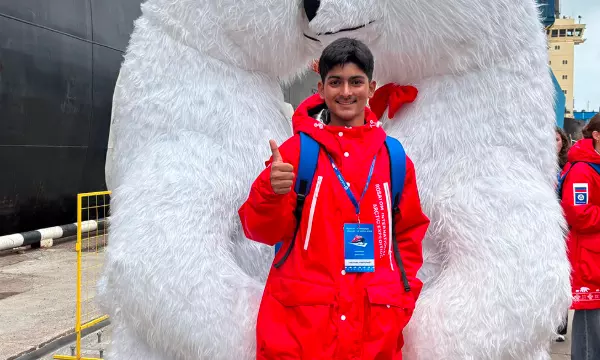
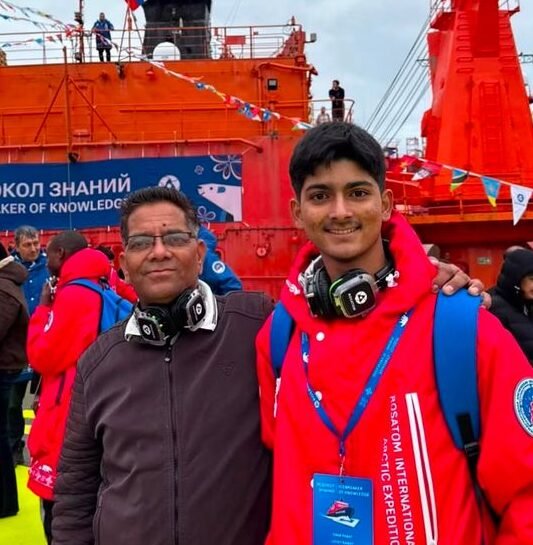
Seventeen-year-old Lucky Rawat from Uttarakhand has been selected as India’s only representative for the prestigious Icebreaker of Knowledge international scientific expedition to the geographic North Pole. His selection marks a significant achievement for the young student, who successfully cleared a rigorous multi-stage selection process to earn a place among participants from across the world.
Hailing from Chakrata in Uttarakhand, Lucky was chosen after outperforming numerous applicants through a three-phase evaluation designed to identify students with exceptional aptitude and interest in science. Only one student from each participating country was selected, making the programme highly competitive. The 10-day expedition commenced from Murmansk, Russia, aboard the nuclear-powered icebreaker 50 Let Pobedy (50 Years of Victory). The vessel is transporting students to the geographic North Pole, located at 90 degrees north latitude, while serving as a platform for scientific learning and international collaboration.
Participants from 22 countries are taking part in the programme, which brings together young students to explore Arctic science, climate research, and environmental conservation. Along with educational sessions led by experts, the expedition offers opportunities for cultural exchange and interaction among students from diverse backgrounds.
Expressing his excitement, Lucky said it was an honour to represent India on such a prestigious international platform. He described the opportunity as a dream come true and said he looked forward to learning from scientists and fellow participants while gaining firsthand knowledge of the Arctic region.
His family also expressed pride in his accomplishment. His father said Lucky’s dedication and hard work had helped him secure a place in the globally recognised programme, adding that the achievement would inspire many students from smaller towns to pursue their scientific ambitions. The Icebreaker of Knowledge initiative aims to encourage young minds to take an interest in science, technology, engineering and environmental studies while fostering international cooperation.