Ashoke Sen, a Pioneer in String Theory, Becomes First Indian to Receive the Oskar Klein Medal
News Mania Desk/ Piyal Chatterjee/ 25th October 2026

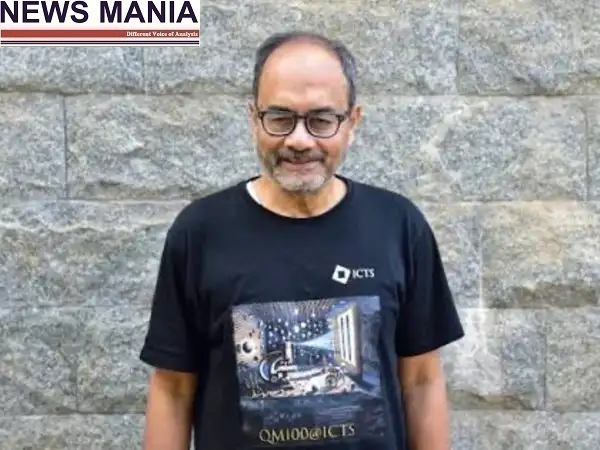
Ashoke Sen, an Indian physicist, is the first recipient of the 2026 Oskar Klein Medal. Many people consider Sen, an ICTS-Infosys Madhava Chair professor at the International Centre for Theoretical Sciences (ICTS)-Tata Institute of Fundamental Research (TIFR), Bengaluru, to be the creator of contemporary string theory.
According to the hypothesis, matter’s fundamental components are not point particles but rather small, one-dimensional, string-like things. As a result, it attempts to provide a cohesive explanation of matter and the forces that exist between them.
The Oskar Klein Medal, which was created in 1988 and named for the Swedish theoretical physicist Oskar Klein, is given out every year by Stockholm University and the Royal Swedish Academy of Sciences’ Nobel Committee for Physics.
Every year, the Oskar Klein Memorial Lectures organising committee asks a famous researcher to present a memorial lecture and accept the Klein Medal in remembrance of Klein.
The talk, “Gravity from Strings and Strings from Gravity,” was delivered by Sen on October 22 at the AlbaNova University Center in Stockholm. In addition to addressing unresolved issues with the quantum theory of black holes, the discussion explained how string theory leads to a consistent quantum theory of gravity.
The research field has been shaped by the contributions of the Padma Shri (2001) and Padma Bhushan (2013) recipient through a number of significant theoretical discoveries, including work acknowledged by the 2012 Breakthrough Prize in Fundamental Physics, which helped establish the notion that all string theories represent distinct limits of the same underlying theory.
ICTS Director Rajesh Gopakumar congratulated Sen, saying, “On behalf of all of us, very warm congratulations to Ashoke. It has been no less than wonderful having Ashoke with us and setting the tone for excellence here at ICTS.”
In a statement, the ICTS said, “Prof. Sen, an ICTS-Infosys Madhava Chair Professor, is internationally recognised for his pioneering work on S-duality, the precision counting of black-hole entropy and string field theory, all of which have helped shape modern string theory.”
Kip Thorne in 2016, Peter Higgs in 2009, Stephen Hawking in 2003, and Nobel Prize winners Hans E. Bethe in 1990, Steven Weinberg in 1989, and Chen Ning Yang in 1988 are among the previous recipients of the Oskar Klein Medal.