
When AI Does the Homework, Who Is Educating the Child?
Ms.Bornali Biswas,Editor in Chief -25th October 2026

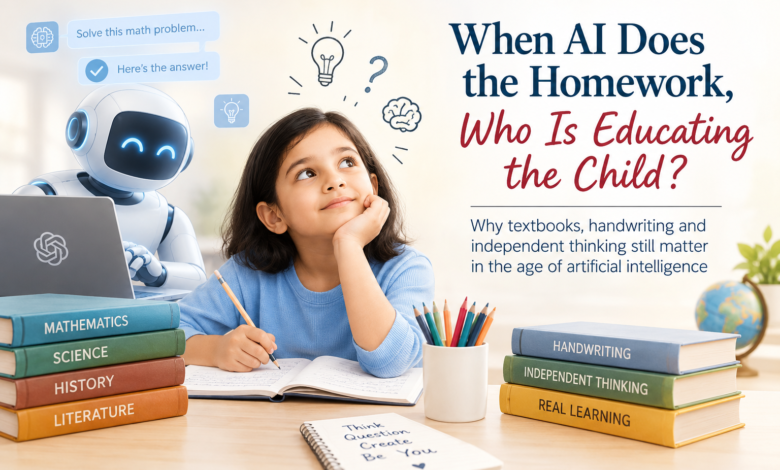
Why textbooks, handwriting and independent thinking still matter in the age of artificial intelligence
This morning, I was surprised to find my Class V niece using ChatGPT to complete her regular homework instead of searching for answers in her textbook. What appeared to be a simple shortcut raised a much bigger question: Are we preparing our children to think independently, or merely teaching them to find the fastest way to finish a task?
Artificial intelligence has transformed the way we access information. It can explain difficult concepts, answer questions instantly and make learning more interactive. However, when children begin using AI to avoid the effort of studying, the very purpose of education risks being undermined and a direct threat to her education.
For a growing child, education is not merely about writing correct answers in a notebook. It is about developing curiosity, concentration, memory, patience and the ability to analyse information. Searching through a textbook, reading a paragraph, identifying relevant points and expressing them in one’s own words are essential learning experiences. These activities may take time, but they help children understand how knowledge is acquired rather than simply delivered.
Traditional learning also teaches an important life lesson: effort is an essential part of growth. A child who struggles with a mathematics problem, searches for a difficult answer or corrects a spelling mistake learns perseverance and self-confidence. If every difficulty is immediately handed over to a machine, children may gradually lose the habit of trying independently.
This does not mean artificial intelligence should be rejected. Technology is here to stay, and children must learn to use it responsibly. AI can be an excellent tutor when it offers hints, explains concepts or encourages students to think further. The danger begins when it becomes a substitute for reading, reasoning and personal effort.
Parents and teachers therefore have a shared responsibility. Children should be encouraged to consult their textbooks first, attempt their homework independently and use AI only when they genuinely need guidance. Most importantly, they should be able to explain every answer they write.
The future will undoubtedly belong to those who understand technology. But it must also belong to those who can question it, verify its answers and think beyond it.
Let AI assist our children, not replace their minds. After all, the purpose of education is not simply to complete homework; it is to develop the ability to learn, reason and make informed decisions throughout life.