Bengaluru CEO Anuradha Tiwari’s ‘Brahmin Genes’ Social Media Post Sparks Controversy

News Mania Desk/Agnibeena Ghosh/26th August 2024
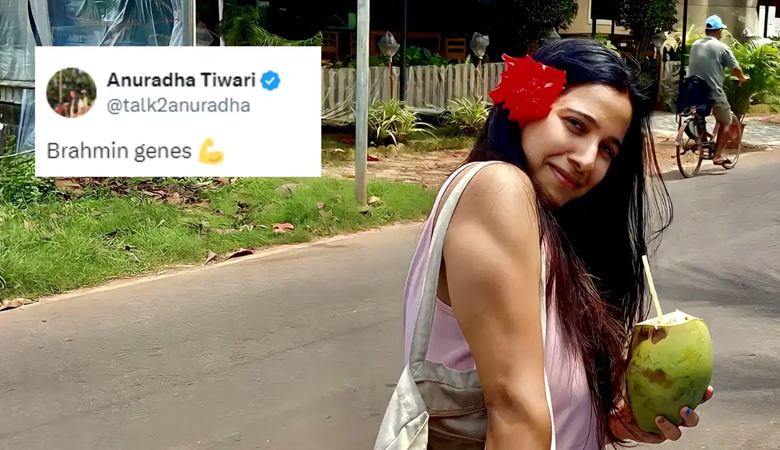
Anuradha Tiwari, a CEO based in Bengaluru, has recently sparked controversy with a social media post that featured a picture of her flexing her triceps while enjoying coconut water. The caption, “Brahmin genes,” has ignited a significant backlash and led to intense debates online. The post quickly went viral, accumulating over 6.1 million views on X (formerly Twitter), with reactions polarized between support and criticism.
Tiwari’s use of the term “Brahmin genes” in her post has drawn accusations of promoting casteism. Critics argue that the reference to her Brahmin identity reinforces caste hierarchies and perpetuates social division. In response to the criticism, Tiwari defended her post in a follow-up message on social media. She expressed frustration over the strong reactions to her mention of “Brahmin,” asserting that her community, which does not benefit from reservations or government incentives, has every right to take pride in their achievements. Tiwari’s response, however, ignored the historical context of Brahmin privilege and systemic advantages in India.
In her post, Tiwari remarked, “As expected, a mere mention of the word ‘Brahmin’ triggered many inferior beings. This reveals who the real casteists are. UCs receive nothing from the system—no reservations, no freebies. We earn everything on our own and have every right to be proud of our lineage. So, deal with it.” Her choice of words, specifically referring to critics as “inferior beings,” has been seen as problematic and indicative of her perceived superiority over those outside her community.
The controversy surrounding Tiwari’s post led to the trending of the hashtag “BrahminGenes” on social media. Renowned author Chetan Bhagat also entered the fray, suggesting that the emphasis on caste issues might be politically motivated. Bhagat opined that focusing on caste could be a strategy to divide Hindu votes, asserting that such discussions, including the “BrahminGenes” trend, could be contributing to political fragmentation within the Hindu community.
Tiwari echoed Bhagat’s sentiments by questioning whether opposition to Brahmins, reservations, or caste census efforts were truly unifying Hindus. She contended that while her community’s stand is criticized, such positions are deemed a threat to Hindu unity. Tiwari’s retort, “Is hatred against Brahmins uniting Hindus? Is Reservation uniting Hindus? Is the Caste Census uniting Hindus? But when Brahmins decide to take a stand for themselves, suddenly, Hindu unity is in danger,” further fueled the debate.
The uproar around Tiwari’s social media activity highlights ongoing tensions related to caste identities and the complex dynamics of privilege and representation in India. As discussions continue, her statements have ignited broader conversations about caste, privilege, and political strategies, revealing deep-seated issues within Indian society and politics.