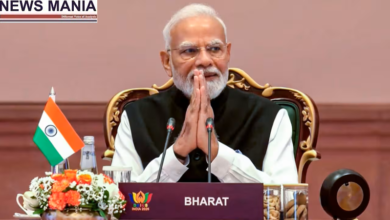
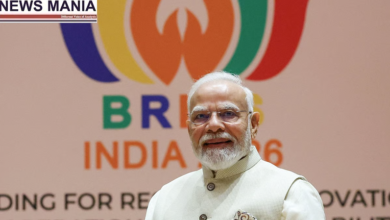
After six years, flights from Guangzhou to New Delhi will resume as Xi and PM Modi meet.
News Mania Desks/ Piyal Chatterjee/ 12th September 2026

China Southern Airlines has announced that flights from Guangzhou to New Delhi will resume after a six-year hiatus ahead of Chinese President Xi Jinping’s visit to India for the BRICS summit. According to Global Times, the airline announced on Saturday that it will start offering regular passenger services on the Guangzhou-New Delhi route on September 21.
The airline stated that it will operate more than 100 weekly flights on its eight round-trip routes in South Asia after the resumption. Due to the COVID-19 outbreak and tensions following the Doklam and Galwan standoffs, India and China have gradually resumed aviation travel this year.
Almost six years after the stoppage, Air India started operating flights between New Delhi and China again in February 2026 earlier this year. When Air China restarted its Beijing-Delhi service in April, it became the second Chinese airline to resume service to India, further boosting direct air connectivity between China and India. The action came after China Eastern Airlines resumed direct service between Kunming and Kolkata on April 18.
An important step in improving air connectivity between India and China was taken earlier on March 30 when IndiGo began its first daily, nonstop service between Kolkata and Shanghai.
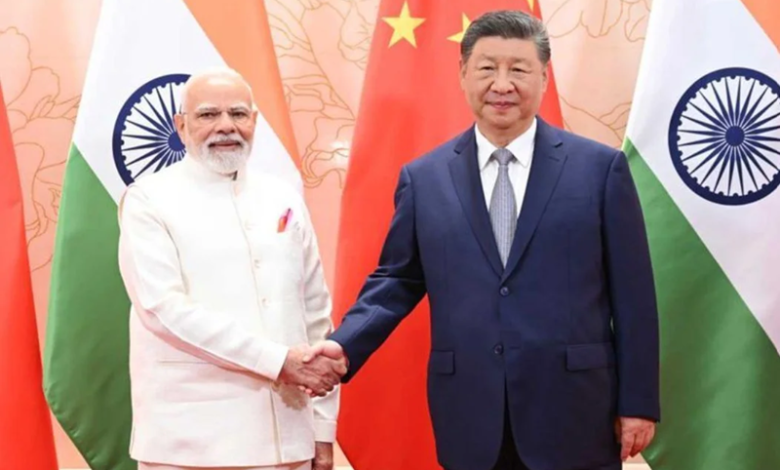
The statement came after direct flights between China and India were confirmed by the Ministry of External Affairs (MEA). At Prime Minister Narendra Modi’s invitation, Chinese President Xi Jinping is currently travelling to New Delhi for the 18th BRICS Summit.
Later on Saturday, PM Modi and President Xi will have a bilateral meeting. After fighting between Chinese and Indian soldiers in the Galwan Valley in 2020, which strained relations for several months, Xi Jinping is making his first trip to India. Since then, relations between China and India have improved, with the Chinese President meeting PM Modi in Kazan and Tianjin.
Russia’s Rosatom Offers India Wider Nuclear, Critical Mineral Cooperation
Piyal Chatterjee
Russia’s state-owned nuclear energy company Rosatom has offered India access to a wider range of nuclear technologies, including large-capacity reactors and small modular reactors (SMRs), while also proposing deeper cooperation in critical minerals and advanced manufacturing.
The proposals were discussed on the sidelines of the 18th BRICS Summit in New Delhi, as India and Russia look to expand their longstanding strategic partnership into newer areas of industrial and technological cooperation. Rosatom senior executive Kirill Komarov said the company was prepared to support India’s ambitious plans to significantly increase its nuclear power generation capacity.
India has set a target of raising its nuclear energy capacity to 100 GW by 2047. Komarov said Rosatom was ready to provide technologies ranging from large nuclear power units to smaller modular reactors to support the country’s long-term expansion plans. Rosatom is already involved in India’s nuclear power sector through the Kudankulam Nuclear Power Plant in Tamil Nadu. Two units of the plant, based on VVER-1000 technology, are operational, while four additional units are at different stages of implementation.
The company is now offering India its more advanced VVER-1200 reactor technology as it seeks to expand its nuclear partnership beyond Kudankulam. The first two Kudankulam units were connected to India’s national power grid in 2013 and 2016. According to Rosatom, the two reactors had generated more than 132 billion kWh of electricity by April 2026.
Beyond nuclear energy, Rosatom is also seeking to expand its presence in India’s critical-mineral sector. The Russian company has identified titanium, zirconium, hafnium and calcium as potential areas of cooperation. Its subsidiary Rosatom MetalTech is also exploring opportunities related to rare-earth magnets and the development of additional production capacity.
A concrete project has already emerged from these discussions. Rosatom’s Giredmet Institute and Indian company Alt Metals have signed an agreement to develop a pilot facility for producing titanium sponge, an important material used in aerospace, defence and other advanced industrial applications. The Russian group is also working with Indian partners to localise advanced manufacturing technologies. Its additive manufacturing division is developing technology-transfer programmes, turnkey additive manufacturing centres and locally produced equipment.
Rosatom said production of its Russian-developed 3D scanners had begun in India this year. Local manufacturing has reportedly lowered equipment costs for Indian customers by around 40%, while the products may also qualify for local-product status under the Make in India programme.
The latest proposals come after Prime Minister Narendra Modi met Russian President Vladimir Putin in New Delhi on September 11, ahead of the BRICS Summit. The two leaders reviewed bilateral cooperation in areas including energy and industrial development, while also discussing the goal of increasing India-Russia bilateral trade to $100 billion by 2030.