Adani promises to invest Rs 1 trillion in Bengal’s “second karmabhoomi” by 2035.
News Mania Desks/ Piyal Chatterjee/ 25th September 2026

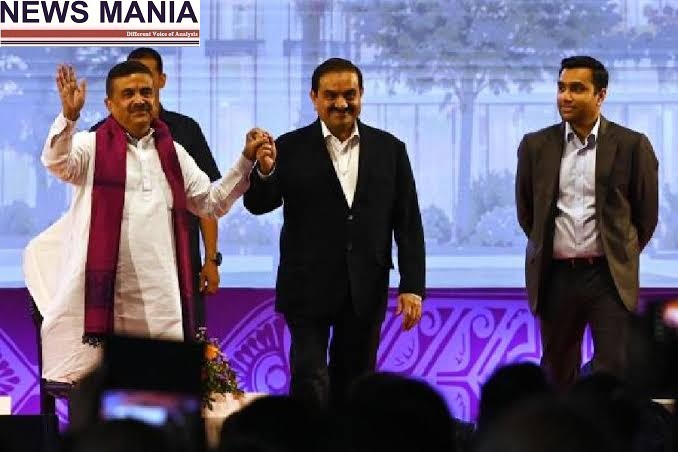
From a deep-sea port and data centers to the Durga Puja, Bengal will bear the Adani brand in a number of areas. Gautam Adani, a billionaire businessman, offered Bengal ₹1 lakh crore in investments by 2035 in a variety of industries, many of which he already has a strong presence in elsewhere in the nation.
He was in Calcutta for the laying of the foundation stones for a 2,000-bed hospital that his group plans to construct in New Town, east of the city, at a cost of more than ₹4,000 crore. The Adani Arogya Mandir is being billed as a “world-class healthcare research and medical education institution” where half the beds will be for the economically weaker sections.
Additionally, the Adani Group has signed two Memorandums of Understanding with the Bengal government, pledging to sponsor Calcutta’s Durga Pujas through an Adani Pujo Preview and to restore the Writers’ Buildings. Chief Secretary Manoj Agarwal and Chief Minister Suvendu Adhikari stood behind Adani and his son Karan.
Since gaining office in May, Bengal’s new BJP administration may have made its most prominent investment pledge on Thursday. Suvendu described the occasion as “historic, important, and auspicious.”
“The Adani family is now interested in investing here, to rebuild West Bengal under the leadership of the BJP government…. Adaniji, please come to help Bengal get back on her feet,” Suvendu said in his address.
Adani seems to be on board already. “Building a stronger Bengal must go beyond any one institution, and the hospital facility is just the beginning,” he remarked. Bengal, according to the businessman, was more than just a place to make investments. He made a comparison to Mundra, Gujarat, which is now the group’s hub for large-scale initiatives.
“Three decades ago, our port at Mundra in Gujarat became our first karmabhoomi — in the west. This morning, as I prayed to Ma at Kalighat, I asked for her blessings that Bengal becomes our second karmabhoomi — in the east,” Adani said. “Because, for me, Bengal is not simply an investment destination. It is a place where I want to build, to serve and most importantly, to belong.”
Adani extolled Bengal as a “land that has demonstrated, generation after generation, an extraordinary ability to produce ideas, institutions and individuals that have shaped India”. This creates a potential for Bengal to become not just a gateway but also one of Asia’s “greatest integrated industrial and economic platforms”, Adani said. “And when this platform connects and expands, something powerful happens in and around Bengal. Ports strengthen logistics.”
“Logistics attracts industry. Industries drive manufacturing. Manufacturing needs energy. Energy enables digital infrastructure — and digital infrastructure brings in the industries of the future. And, most importantly, jobs multiply.”
Adani ended with “Joy Bangla” and “Jai Hind”, surprising many of those sporting saffron scarves in the audience. “Joy Bangla” had been the Trinamool Congress’s catchphrase prior to the Bengal elections. A significant portion of India’s private sector infrastructure, including ports, energy, logistics, and digital frameworks, is under the ownership of the Adani Group.
Bengal had “suffered too much during the communist rule,” according to Suvendu. He claimed that the trade union movement forced the closure of 54 industries. He claimed that “doles” and “appeasement politics” were synonymous with Trinamool governance.