
For the first time this season, Delhi’s AQI surpasses 300, and additional haze is predicted in the days ahead.
News Mania Desk/ Piyal Chatterjee/ 3rd November 2026

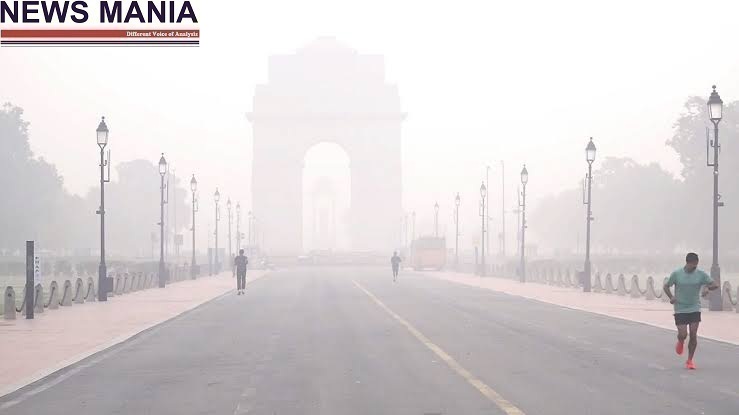
For the first time this season, Delhi’s air quality worsened to the “extremely poor” category on Monday, with a dense haze engulfing the nation’s capital as pollution levels rapidly increased following last week’s brief respite brought on by rain. At 7:05 a.m. on Monday, the Air Quality Index (AQI) was 307.
According to the Central Pollution Control Board (CPCB)‘s 4 p.m. report, the city’s 24-hour average AQI was 261 (poor) on Sunday, a significant decline from 117 (moderate) the day before. Following a period of intense rain that cleared Delhi’s air of pollutants, Friday’s AQI was 60, making it the cleanest October day in four years.
Data was available for 58 of Delhi’s 59 air quality monitoring stations. With an AQI of 417, Jahangirpuri was the lone station in the “severe” category, while 36 of them had “extremely poor” air quality. The remaining stations had “bad” air quality, while five stations had “moderate” air quality.
According to CPCB, an AQI of 0–50 is considered “good,” 51–100 is considered “acceptable,” 101–200 is considered “moderate,” 201–300 is considered “poor,” 301–400 is considered “very poor,” and 401–500 is considered “severe. 51 of the 58 reporting stations had PM2.5 as the predominant pollutant at 6 a.m. on Monday, while the remaining seven had PM10. PM2.5 was the primary pollutant at 46 out of 57 sites at the same time the day before, while PM10 was detected at 11.
On February 11 of this year, Delhi’s air quality was last reported as “extremely poor,” with a 24-hour average AQI of 305. Prior to it, on February 4, the AQI was 339. A week before Diwali, when firecracker explosions usually increase the amount of pollutants in the air in the capital, there is an increase in pollution levels.
Between October 1 and November 1, 1,394 farm fires were found in Punjab and Haryana, with 1,249 occurring in Punjab and 145 in Haryana, according to NASA satellite data. On November 1st, 171 of these were noted. The satellite found 1,861 flames over the same time last year.
Indeed, as stubble burning has shifted to later hours of the day, the numbers might not be directly comparable. Compared to 94% in 2024, almost 98% of the fire heat detected by Meteosat in 2025 occurred after 3 pm. Since most burning currently occurs after the satellite passes at roughly 1.30 pm, the numbers from both years are probably underestimates. The smog season has arrived, according to meteorologist Navdeep Dahiya, and unfavorable weather is expected to make pollution levels worse over the next few days.
“Most AQI sensors across Delhi NCR are now reporting AQI levels above 300 and many are climbing the 400-500 range tonight. The flow of winds are from the north west with calm conditions. All emissions will persist in the atmosphere for longer duration,” he said in a post on X.