Two friends recognized the worth in the straw that farmers set ablaze. Currently, Their Business Generates Rs 8 Crore in Revenue.
News Mania Desk/ Piyal Chatterjee / 11th November 2026

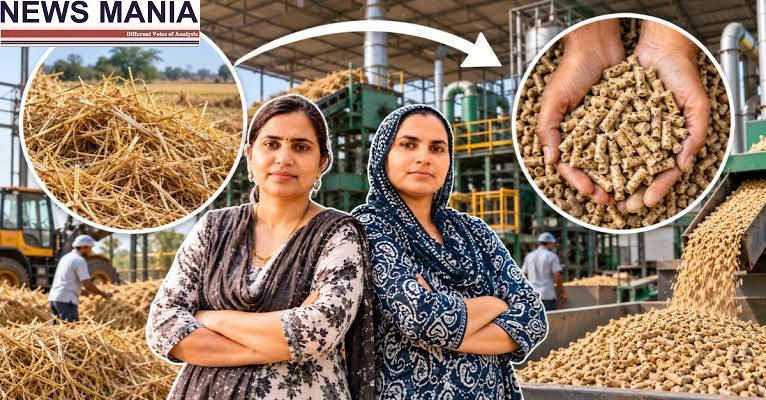
Annually, after the paddy harvest concludes, farmers throughout Haryana encounter a recurring issue. Their fields are scattered with residual straw, and they must tidy the land prior to sowing the upcoming crop. For numerous people, igniting this stubble is the fastest answer. However, the smoke that emanates from these fields contributes to the already serious air pollution in North India. Now picture if that same straw could generate income, create employment, and also assist in powering industries. That’s precisely what two women from Haryana and the adjacent state of Rajasthan aimed to achieve.
Sanjana, a graduate from Ghoranwali village in Haryana’s Sirsa district, along with her friend Sonika, from Bhadra in Rajasthan, identified a business opportunity in something that farmers found difficult to dispose of. They chose to gather excess paddy straw, known locally as parali, and convert it into biofuel pellets suitable for use as an alternative fuel in power plants. In 2024, they established SSAR Biomass Green Private Limited with an investment of around Rs 2.5 crore. Currently, the business reports an annual revenue of Rs 7–8 crore and has more than 20 employees. For Sonika, the concept originated from a scene she had observed many times following the paddy harvest: dense smoke billowing in the sky as farmers set fire to crop remnants.
Worried about the impacts on the environment and public health, she started considering how this agricultural waste could be utilized more effectively. Instead of viewing stubble burning as an issue lacking straightforward solutions, she and Sanjana began investigating methods to transform the residue into a product with commercial value. The concept aimed to meet two needs simultaneously: provide farmers with a viable use for their remaining crop residue and develop an alternative fuel for industrial applications. Policies and initiatives from the government advocating for stubble management contributed to the opportunity for the venture to develop.
In 2024, Sanjana and Sonika established their manufacturing facility in Ghoranwali with an investment nearing Rs 2.5 crore through the Agriculture Infrastructure Fund (AIF) program.
The factory implements a procedure that starts in the fields. The women obtain paddy straw from baler operators in Sirsa and nearby regions. These machines gather and compact the loose debris, simplifying transportation and storage.
The stubble is subsequently transported to their factory, where equipment converts it into dense biofuel pellets. These pellets may be provided to power plants as a substitute fuel. The project’s influence goes beyond the pellets it generates. SSAR Biomass Green Private Limited establishes a market for paddy straw, thereby creating opportunities for local baler operators and individuals engaged in the collection and transportation of the residue.
The factory directly offers jobs to over 20 individuals, offering local employment opportunities for those living in and near the village. Starting with an initial investment of around Rs 2.5 crore, Sanjana and Sonika have created a business that generates an annual revenue of Rs 7–8 crore. For the two founders, the upcoming harvest season will provide another chance to acquire additional stubble, maintain production, and grow their business. Their efforts have provided farmers in the area with an alternative method for handling crop residue, while establishing a market for materials that would otherwise hold minimal economic worth.