
SpaceX Successfully Catches Starship’s Upper Stage, Marks Major Milestone in Reusable Rocket Technology
News Mania Desk/ Piyal Chatterjee/ 17th November 2026

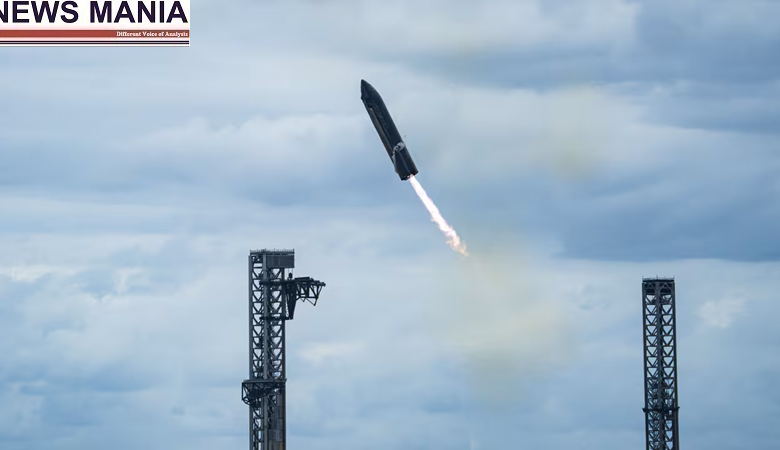
SpaceX has achieved a significant breakthrough in its efforts to develop a fully reusable rocket system after successfully catching the upper stage of its Starship rocket using giant mechanical arms at its Starbase launch facility in Texas. The achievement marks an important step towards making space travel more economical and expanding the possibilities of future missions to the Moon and Mars.
The recovery took place during Starship’s 15th test flight, in which the spacecraft completed 14 orbits around Earth before returning. The upper stage was caught by a pair of enormous mechanical arms, popularly known as ‘chopsticks’, installed on the launch tower. The system is designed to capture returning rocket stages and eliminate the need for conventional landing platforms or recovery ships.
The latest mission was particularly significant because SpaceX attempted to recover both components of its Starship launch system during a single flight. While the upper stage recovery was successful, the Super Heavy booster could not be recovered. The booster was redirected towards a controlled splashdown in the Gulf of Mexico but exploded before reaching the water.
Despite the setback involving the booster, the mission achieved several important objectives. Starship successfully deployed 26 Starlink Version 3 satellites into orbit, demonstrating its ability to carry and release payloads during flight. The successful deployment also provided valuable information for SpaceX’s plans to use Starship for future satellite launches.
The company’s long-term objective is to establish a fully reusable transportation system capable of carrying large quantities of cargo and passengers into space. Unlike conventional rockets, which discard major components after launch, Starship is being developed to return both stages to Earth for refurbishment and repeated use.
SpaceX believes that recovering and reusing rocket components could substantially reduce launch expenses while increasing the frequency of space missions. The technology is also expected to play an important role in supporting NASA’s future lunar exploration plans and Elon Musk’s ambition of sending humans to Mars.