4.1-Billion-Year-Old Martian Meteorite Discovered in Sahara Desert Offers Clues to Mars’ Ancient History
News Mania Desk/ Piyal Chatterjee/ 6th November 2026

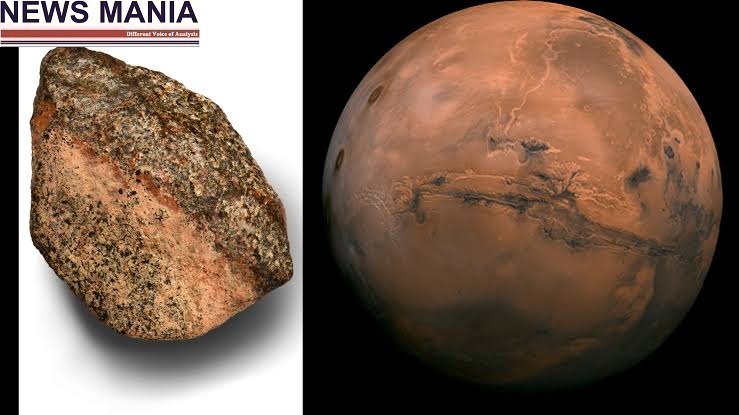
A rose-coloured rock discovered in the Sahara Desert in 2022 has turned out to be a 4.1-billion-year-old fragment of Mars, offering scientists valuable insights into the Red Planet’s early geological history. The discovery is providing fresh evidence of ancient water activity on Mars and could help researchers understand the planet’s environment billions of years ago.
Named Teghaza 001 after the salt plain in Mali where it was recovered, the meteorite weighs approximately 800 grams. Scientists have identified it as one of the oldest known Martian meteorites found on Earth. Its unusual mineral composition has attracted considerable scientific interest because it preserves clues about the conditions that existed during the early formation of Mars.
A research team led by Yang Liu of NASA’s Jet Propulsion Laboratory examined the specimen to determine its age and origin. The findings were published in the journal Science on October 29, 2026. Researchers studied its mineral structure, oxygen isotopes and zircon crystals to reconstruct its geological history.
The analysis revealed that the rock underwent significant alteration through exposure to water approximately 4.1 billion years ago. This suggests that water was interacting with parts of the Martian crust during the planet’s early development. Scientists believe the original rock may have formed even earlier before undergoing these changes. Researchers also used an advanced dating technique that allowed them to examine extremely small mineral samples without consuming large portions of the rare meteorite. The approach could help preserve the remaining specimen for further investigations.
Based on its mineral characteristics and comparisons with observations from NASA’s Mars Reconnaissance Orbiter, scientists suspect that Teghaza 001 may have originated in Mars’ southern highlands. However, its precise location of origin has not yet been established. The discovery is significant because it provides direct evidence of ancient geological processes involving water on Mars. Studying the meteorite could improve scientific understanding of the planet’s early crust, volcanic activity and environmental conditions.