
“Everyone Has a Little OCD” – A Dangerous Myth About Mental Health
By Ms.Bornali Biswas-Editor in Chief- 27- November 2026

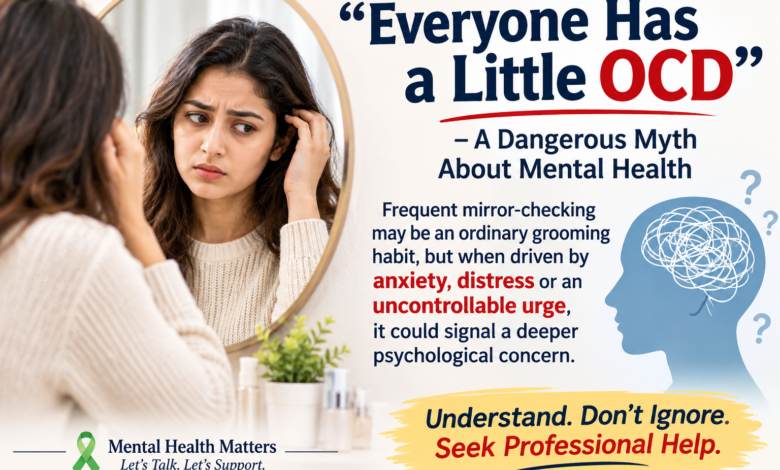
Frequent mirror-checking may be an ordinary grooming habit, but when driven by anxiety, distress or an uncontrollable urge, it could signal a deeper psychological concern.
“Everyone has a little OCD” has become a casual expression in everyday conversations, often used to describe people who like things organised, repeatedly check their appearance or prefer everything to be perfectly arranged. However, this popular assumption trivialises a serious mental health condition. Obsessive-Compulsive Disorder (OCD) is not a personality trait, a preference for cleanliness or simply an obsession with perfection. It is a clinically recognised disorder that can significantly interfere with everyday life.
Consider a familiar situation: someone checks their reflection every time they pass a mirror. Is it OCD? Not necessarily. A quick glance to adjust one’s hair, clothing or appearance is a normal human habit. The distinction lies in the frequency, emotional motivation and psychological distress associated with the behaviour.
When Mirror-Checking Becomes a Concern
Frequent and compulsive mirror-checking may be associated with Body Dysmorphic Disorder (BDD), a condition characterised by persistent preoccupation with perceived physical flaws that appear minor or unnoticeable to others.People experiencing BDD may repeatedly scrutinise particular facial features, compare their appearance with others or seek reassurance. Although checking the mirror may temporarily reduce anxiety, it often reinforces the cycle of dissatisfaction and distress.
OCD can also involve repetitive checking, but the underlying fear may be different. A person might repeatedly examine their face because of an intrusive fear of a medical problem, asymmetry or another imagined consequence. The behaviour becomes a compulsion performed to reduce anxiety or prevent a feared outcome.
The Clinical Difference Matters
BDD and OCD are classified as separate conditions, although they belong to the same broader family of obsessive-compulsive and related disorders. Both can involve intrusive thoughts, repetitive behaviours and significant emotional distress. However, their underlying concerns and treatment approaches may differ.Clinically, specialists assess how much time these behaviours consume, whether the individual feels compelled to perform them, and whether they interfere with relationships, work or social life.The larger concern is society’s tendency to turn psychiatric diagnoses into fashionable adjectives. Calling every organised person OCD or every appearance-conscious individual obsessive reinforces stigma and discourages people experiencing genuine symptoms from seeking help.Mental health conditions deserve understanding, not casual labels. If repetitive checking becomes difficult to control or causes significant distress, professional assessment by a qualified mental health specialist is important.
Being particular about appearance is normal. Feeling trapped by the need to check it repeatedly is not something that should be casually dismissed as a quirk.