“Jantar Mantar 2”: If Gyanesh Kumar doesn’t step down within 48 hours, the CJP threatens protests
News Mania Desks/ Piyal Chatterjee/ 25th September 2026

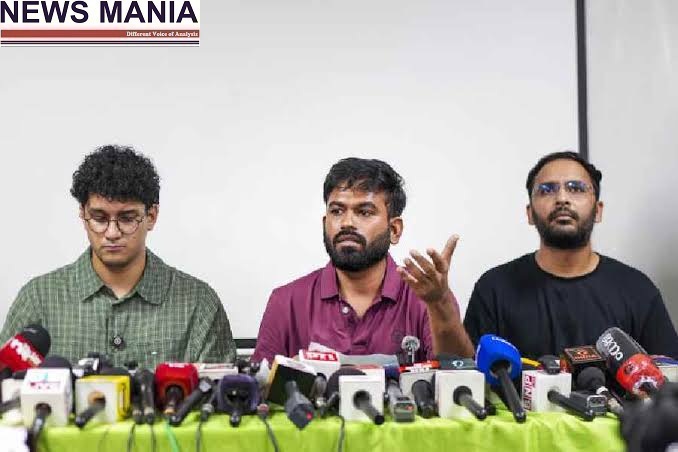
Gyanesh Kumar has 48 hours to step down as India’s chief election commissioner, according to the Cockroach Janta Party (CJP), which threatened “Jantar Mantar 2”-style demonstrations if he didn’t. “If within 48 hours Gyanesh Kumar doesn’t resign, we will hold a nationwide protest,” CJP founder Abhijeet Dipke said at a press conference.
The Indian Express revealed two election commissioners’ objections to decisions made by the Election Commission of India on the countrywide Special Intensive Revision (SIR) of electoral rolls in investigative reports on Wednesday and Thursday, which prompted the threat from the youth-focused organization. Party comrades Sourav Das and Asutosh Ranka joined Dipke, and they talked about the findings from The Indian Express and the purported cooperation between the ruling BJP and the ECI.
The CJP made three key demands:
- Kumar’s removal and criminal proceedings against him, along with disclosure of who ordered the alleged illegal actions.
- An immediate halt to all upcoming polls and the constitution of an independent inquiry commission to examine the SIR’s entire decision-making process.
- A new law to reconstitute the Election Commission in a way that inspires public confidence.
The CJP, which maintains that it is a pressure organization rather than a political party and that it was responsible for Dharmendra Pradhan’s resignation as India’s education minister, also requested that the Supreme Court seal and transfer the SIR files to its custody “so that no one can claim a fire accident.” Dipke claimed that since Kumar took office, the BJP’s vote share has increased. Voters were not the only ones harmed, according to Dipke, who also claimed that the Election Commission’s own members’ objections were being disregarded.
According to Das, who cited sources from The Indian Express, the findings—which included the removal of 13 crore voters nationwide, 14 complaints in 11 months, and odd techniques of adding and removing names—pointed to a broader conspiracy.
“Voting rights are being snatched, especially of the youth,” he said. Das said Gen Z voters seeking enrolment were being blocked, and that the reports showed “the system has become hollow.”
He said that Form 6, which is used to add new voters, was illegal. New applicants are asked on the questionnaire if their parents were mapped in the previous SIR. The question is optional, according to the ECI’s public statement. He claimed that two Election Commissioners had objected to the topic and that adding such a question would require changing the law, which had not been done.
Das also brought up the SIR in Bengal, where about 60 lakh voters were eliminated due to “logical discrepancy”—typically name discrepancies or issues with parental identity data.
A Supreme Court judgment later resulted in the addition of about 33 lakh names.
The ECI contested that order, according to Das. The founder of the CJP inquired as to who was challenging the commission’s decision to add voters, a point that the Express stories had also highlighted. The commissioners of the poll body, he claimed, had declared this unlawful but were disregarded. Dipke disagreed with the ECI’s assertion that district-level Electoral Registration Officers (EROs) independently oversee additions and removals and that electoral rolls are not generated centrally.