ESA’s Hera spacecraft reveals massive crater on Dimorphos after NASA’s DART impact
News Mania Desk/ Piyal Chatterjee/ 28th November 2026

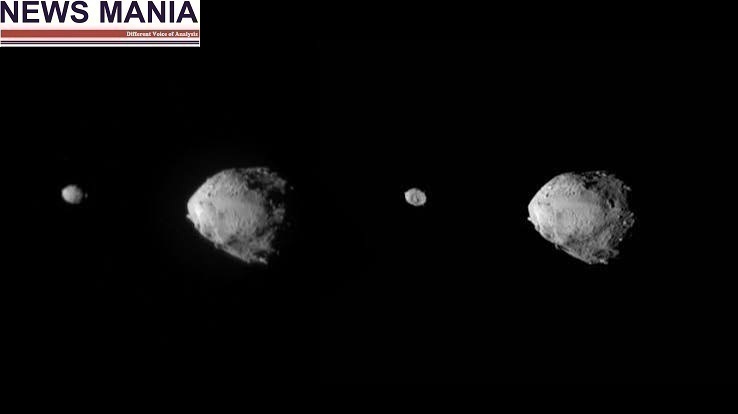
The European Space Agency’s (ESA) Hera spacecraft has captured fresh images of asteroid Dimorphos, revealing the extensive damage caused by NASA’s Double Asteroid Redirection Test (DART) mission in 2022. The observations are helping scientists investigate how the collision altered the asteroid’s surface, shape and rotational behaviour, offering new insights into the effectiveness of planetary defence technologies.
Dimorphos, which orbits the larger asteroid Didymos, was deliberately struck by NASA’s DART spacecraft in September 2022. The mission was designed to test whether a spacecraft could change the trajectory of an asteroid by colliding with it. The experiment successfully shortened Dimorphos’ orbital period around Didymos, demonstrating that a kinetic impact could influence the movement of a celestial body.
The latest images captured by Hera show a substantial crater and considerable surface deformation on Dimorphos following the collision. Scientists are examining the impact site to determine how the asteroid’s structure responded to the force of the spacecraft and how debris was displaced during the event. The findings could help researchers understand whether Dimorphos behaved like a solid rocky object or a loosely assembled collection of material during the collision. Such information is crucial for developing effective asteroid-deflection strategies, as the outcome of an impact depends heavily on the target’s composition, density and internal structure.
Hera’s observations have also raised questions about the asteroid’s rotational stability. Researchers are investigating evidence suggesting that Dimorphos may now be tumbling chaotically, potentially as a consequence of the collision. Understanding these changes could reveal how impacts affect the dynamics of small asteroids and their movement through space.
The spacecraft has also observed numerous boulders scattered around the Didymos–Dimorphos system. Scientists are studying these fragments to reconstruct the impact process, assess the amount of material ejected and estimate how energy from the collision was transferred to the asteroid.
While DART was primarily designed to strike Dimorphos and measure the immediate consequences of the collision, Hera is undertaking a detailed follow-up investigation. The mission will study the asteroid system’s mass, surface composition, physical structure and impact damage, providing measurements that were not possible during the original experiment. The DART experiment marked a major milestone in planetary defence by demonstrating that a spacecraft could alter an asteroid’s orbital motion. Hera’s detailed observations could now help turn that demonstration into a more reliable strategy for protecting Earth from future asteroid threats.