
2025 Nobel Prize in Economics Awarded to Mokyr, Aghion, and Howitt for Groundbreaking Work on Innovation and Economic Growth
News Mania Desk / Piyal Chatterjee / 13th October 2025

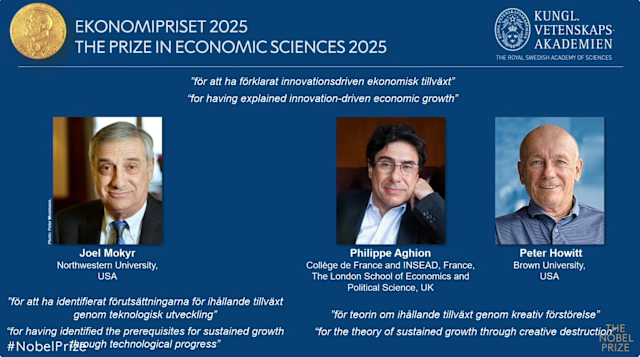
The 2025 Nobel Memorial Prize in Economic Sciences has been awarded to Joel Mokyr, Philippe Aghion, and Peter Howitt for their pioneering research on how innovation can prevent economic stagnation and drive sustained growth. The Royal Swedish Academy of Sciences highlighted their work in explaining the mechanisms through which technological progress and creative disruption shape modern economies.
Joel Mokyr, an economic historian at Northwestern University, received half of the prize for his research into the historical factors that enable technological advancements to become long-term engines of economic growth. Mokyr’s work emphasizes how societies that cultivate knowledge, education, and institutional openness create fertile ground for innovation.
The remaining half of the prize was shared by Philippe Aghion (Collège de France and INSEAD) and Peter Howitt (Brown University) for their development of formal models of creative destruction, a process in which new technologies replace older ones, continually renewing the economy. Their mathematical frameworks demonstrate how innovation fosters productivity gains and prevents stagnation, providing policymakers with tools to understand long-term economic dynamics.
The Academy stressed that, historically, periods of economic stagnation have been far more common than sustained growth, and innovation is key to avoiding such stagnation. Their combined research underscores the importance of open markets, competitive environments, and institutional support to maintain ongoing technological progress.
Aghion has also highlighted contemporary challenges to innovation, including rising protectionism, market concentration, and trade barriers, which could slow the pace of technological advancement. The laureates’ work is especially relevant in today’s context, as economies grapple with rapid technological change, artificial intelligence, climate-related innovations, and global inequality.
The Nobel Prize in Economics carries a cash award of 11 million Swedish kronor and concludes this year’s Nobel announcements. Experts say the selection reaffirms the importance of fostering innovation as the cornerstone of sustainable economic growth in an increasingly complex and interdependent global economy.