
36 billion times the size of Sun: Biggest black hole ever discovered
News Mania Desk / Piyal Chatterjee / 10th August 2025

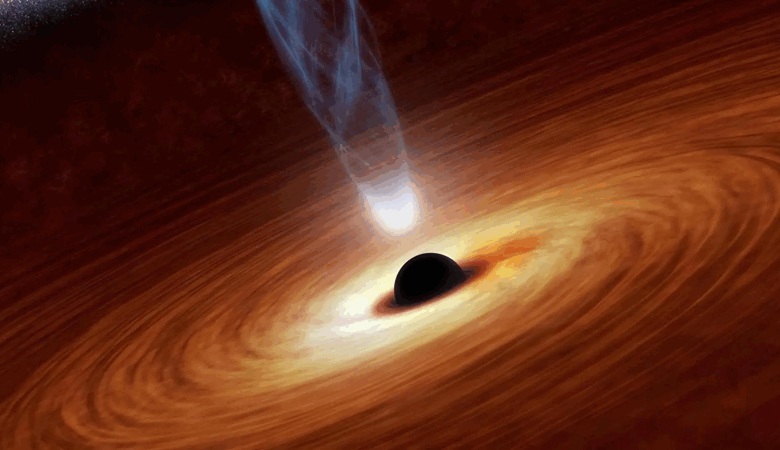
The discovery of a cosmic behemoth by astronomers that may be the largest black hole ever discovered pushes the limits of our knowledge of these mysterious objects.
At an incredible 36 billion times the mass of our Sun, this ultramassive black hole dwarfs the black hole at the center of the Milky Way by a factor of 10,000. It is situated around 5 billion light-years from Earth in the center of the Cosmic Horseshoe, one of the biggest galaxies known to science.
Light from a more distant galaxy is bent into a remarkable horseshoe-shaped Einstein ring by the Cosmic Horseshoe galaxy’s immense size, which distorts spacetime itself.
It is within this vast gravitational lens that researchers have detected the ultramassive black hole, using an innovative method that combines gravitational lensing—the bending of light by massive objects-with stellar kinematics, the motion of stars around the black hole.
“This is amongst the top 10 most massive black holes ever discovered, and quite possibly the most massive,” said Professor Thomas Collett of the University of Portsmouth, who led the research.
This study benefits from two pieces of data, unlike most black hole mass determinations, which are indirect and frequently uncertain: stars in the black hole’s vicinity move at breakneck speeds of about 400 kilometers per second, and the black hole’s enormous gravitational attraction bends light from background galaxies. Its tremendous bulk is much more certain thanks to this combination.
The term “dormant” refers to the ultramassive black hole’s current state, in which it is neither consuming matter nor glowing brilliantly like quasars.
Rather, its gravitational pull on surrounding matter and light is the only indication of its existence. The importance of this method was emphasized by lead researcher Carlos Melo of the Universidade Federal do Rio Grande do Sul in Brazil, who stated that it enables astronomers to find and quantify concealed black holes, even when they are silent.
Understanding the co-evolution of galaxies and their center black holes will be greatly impacted by this revelation. Similar to the Cosmic Horseshoe, the Milky Way’s black hole is a relatively small four million solar masses in our own cosmic neighborhood. It has a history of quasar activity and has the potential to develop in the future.