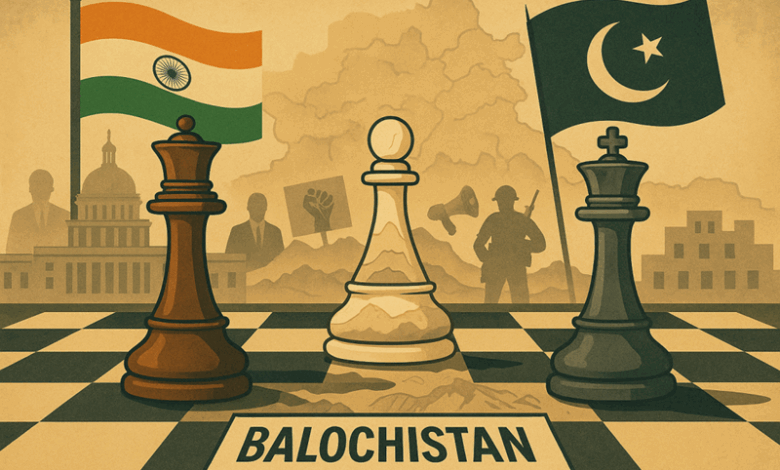
The dawn of Balochistan- What does it mean for India? Who are the key players in this nation? Will the new nation cause a stir in South Asia?
News Mania Desk / Piyal Chatterjee / 16th May 2025

Baloch nationalist leaders have declared independence from Pakistan, citing decades of violence, enforced disappearances, and human rights violations in the region. Social media was flooded with images of Balochistan’s proposed national flag and maps of an independent Baloch state, as ‘Republic of Balochistan’ trended widely across platforms. Prominent Baloch activist and writer Mir Yar Baloch said that people across Pakistan-occupied Balochistan have taken to the streets, voicing their demand for independence with mass protests and declaring that “Balochistan is not Pakistan.” In a social media post, Mr. Mir urged the international community and the United Nations to recognise the “Democratic Republic of Balochistan” as a sovereign state.
The Baloch independence movement has strong historical foundations, originating in 1947 when the princely state of Kalat momentarily proclaimed independence after the partition of British India. In 1948, Pakistan forcibly annexed it, a decision that Baloch nationalists have always rejected. Activists such as Mir Yar Baloch contend that the area’s extensive natural resources, especially gas and minerals, have been exploited by Islamabad, leaving the local populace marginalised. Currently, Balochistan is still the most impoverished and underdeveloped province in Pakistan.
As the movement gains fresh visibility, here’s an overview of the key figures in the Baloch nationalist and separatist movement:
Mir Yar Baloch: He is considered to be the figure behind the recent announcement and is also becoming a prominent voice in the exiled Baloch community. Located in Europe, he has addressed international forums, such as the United Nations, highlighting issues like enforced disappearances, military oppression, and the exploitation of Balochistan’s natural resources. His candid activism mirrors an expanding digital and diplomatic opposition movement.
Bashir Zaib: The existing head of the Baloch Liberation Army (BLA), Bashir Zeb, or Bashir Zaib, stands out as a significant and contentious personality in the armed opposition. He took charge following the death of Aslam Baloch in a suicide bombing in Afghanistan in 2018. Under his leadership, the BLA has ramped up activities against Pakistan’s security forces and Chinese initiatives associated with CPEC (China-Pakistan Economic Corridor). Zeb embodies the more extreme faction of the movement, advocating for complete secession and military conflict. He has issued several alerts to foreign individuals, especially Chinese citizens, urging them to exit Balochistan, labeling their presence as a type of “neo-colonialism.” Pakistan has labeled him a terrorist, yet his supporters see him as a freedom fighter carrying on the tradition of resistance.
Mehran Marri: Mehran is the offspring of seasoned Baloch nationalist Khair Bakshi Marri and a key figure in the leadership abroad. Situated in Switzerland, he heads the United Baloch Army (UBA) and has continually advocated for global acknowledgment of Balochistan’s right to self-determination. In 2017, he was temporarily held in Switzerland over accusations of extremist connections, which he refutes.
Brahumdagh Bugti: He is the grandson of murdered Baloch leader Nawab Akbar Bugti and leads the Baloch Republic Party (BRP). Bugti has been functioning from exile in Switzerland and has requested asylum in multiple nations. Initially regarded as a moderate, his position has become more rigid over time because of Pakistan’s ongoing military actions in Dera Bugti and other areas.
Allah Nazar Baloch: Once a medical doctor, Dr Allah Nazar Baloch is now a guerrilla leader and heads the Balochistan Liberation Front (BLF). Based primarily in Balochistan, he is regarded as one of the rare militant leaders who has not sought exile. He has withstood various assassination attempts and persists in releasing statements from hiding.
Hyrbyair Marri: A different son of Khair Bakhsh Marri, Hyrbyair heads the Balochistan Liberation Movement (BLM) and resides in the UK. He proactively advocates to Western governments for intervention in Balochistan.
Balochistan is the largest province in Pakistan in terms of area, representing almost 44% of the nation’s total land, yet it is the most sparsely populated and least developed area. Abundant in natural resources such as natural gas, coal, copper, gold, and uranium, Balochistan has been the center of a persistent conflict between the Pakistani government and Baloch ethnic nationalists.
The origins of Balochistan’s demand for independence trace back to 1948, when the princely state of Kalat, now within Balochistan, was incorporated into Pakistan after initially pursuing independence following Britain’s departure from the Indian subcontinent. Numerous Baloch perceive this annexation as coercive and unauthorized. Since that time, five significant uprisings have occurred, all faced with severe military responses.
Baloch nationalists contend that the area’s resources are consistently exploited, leaving its inhabitants impoverished, marginalized, and politically ignored. The presence of the Pakistani military in the area is greatly disliked, with regular claims of enforced disappearances, extrajudicial killings, and collective punishment. Initiatives such as the China-Pakistan Economic Corridor (CPEC), which traverses Balochistan, have increased discontent among residents, who claim they gain no advantages from the extensive infrastructure funding while enduring militarization and displacement.
In the past few days, multiple Baloch activists have indicated a strong desire to obtain India’s assistance, both diplomatically and strategically. Activists such as Mir Yar Baloch and Brahumdagh Bugti have made appeals for New Delhi to acknowledge the struggles of the Baloch people and to show support in global platforms. Baloch leaders contend that similarly to how India supported Bangladesh in 1971, it should now speak out against what they term Pakistan’s “colonial occupation” of Balochistan. The initiative is viewed as a calculated effort to address Pakistan’s ongoing proxy warfare in Kashmir and to highlight Balochistan’s fight on the international stage.