The Beginnings and Background of Bengal’s Bauls
News Mania Desk / Piyal Chatterjee / 4th July 2025

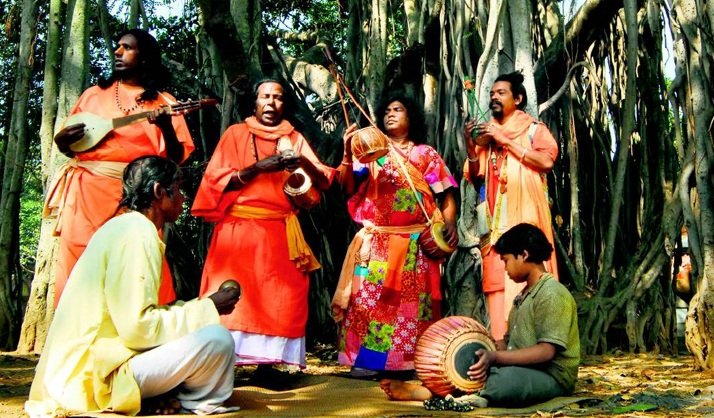
The enigmatic Baul music tradition is not only distinctive to Bengal but also holds a significant position in the history of global music. The term “Baul” derives etymologically from the Sanskrit words “Vatula” (madcap) or “Vyakula” (restless) and is frequently used to refer to someone who is “possessed” or “insane.”
Initially, the Bauls were merely nonconformists who opposed conventional social standards to create a unique sect that valued music as their faith. “Baul” is the term used for the style of folk music created by this inventive community. A Baul singer can be recognized by his untrimmed, frequently twisted hair, saffron garment (alkhalla), a necklace created from basil (tulsi) stems, and notably, the one-string guitar (ektara). Music serves as their sole means of survival: Bauls rely on whatever locals provide in exchange, as they journey from one location to another, effectively riding the wave of their own joy.
The population primarily comprises Vaishnava Hindus and Sufi Muslims. Their unique clothing and musical instruments often make them easy to recognize. Little is known about their beginnings, although it is speculated that the sect of wandering musicians might trace back to the 9th century CE. It is only in the mid-18th century that historians recognize them as a significant, identifiable cult. Bauls sing passionately and express their emotions in their songs, yet they never take the time to document them, as their tradition is fundamentally oral. Lalan Fakir (1774 -1890), the most esteemed of all Bauls, is known to have composed and sung songs for many years without pausing to revise them or transcribe them. Only after his passing did people consider gathering and organizing his extensive collection.
Bauls reside as a community, and their primary focus is the promotion of Baul music. Yet they are the least communal of all communities: Collectively, they lack an official religion, as they solely adhere to the faith of music, brotherhood, and peace. Mainly a Hindu movement, the Baul philosophy intertwines various Islamic and Buddhist elements.
Bauls incorporate various native musical instruments to enhance their creations. The “ektara,” a single-stringed drone instrument, is the typical instrument of a Baul vocalist. It is shaped from the outer skin of a gourd and constructed with bamboo and goat hide. Other frequently utilized musical instruments encompass “dotara,” a multi-string instrument crafted from jackfruit or neem wood; “dugi,” a small handheld clay drum; leather instruments such as “dhol,” “khol,” and “goba”; chime devices like “ghungur,” “nupur,” small cymbals termed “kartal” and “mandira,” along with the bamboo flute.
Initially, the Birbhum district in West Bengal was the center of all Baul activities. Subsequently, the Baul territory extended to Tripura in the north, Bangladesh in the east, and regions of Bihar and Orissa in the west and south respectively. In Bangladesh, the regions of Chittagong, Sylhet, Mymensingh, and Tangyl are renowned for Bauls. Bauls from distant regions arrive to take part in the Kenduli Mela and the Pous Mela–the two foremost festivals organized in West Bengal for Baul music.
The Bauls are so central to Bengal that it’s difficult to envision Bengali culture without them. They are not just a fundamental aspect of Bengal’s music, but they also permeate the soil and atmosphere of this region as well as the thoughts and essence of its inhabitants. The essence of the Bauls embodies the essence of Bengal—constantly flowing through its culture and society, literature and art, religion, and spirituality.
Who can deny the impact of Baul songs on Tagore’s Rabindra Sangeet? The enchanting quality of Tagore’s verses is also a result of his connection to these roving minstrels. In The Place of the Hidden Moon (1966), Edward Dimock Jr. states: “Rabindranath Tagore elevated the Bauls to an esteemed status through his admiration for the beauty of their songs and spirit, along with his honest and proud recognition of his own poetic indebtedness to them.” The Baul style also influenced numerous other acclaimed poets, playwrights, and songwriters during the 19th and 20th centuries.
Bauls are performers who blend singing, composing, dancing, and acting, and their goal is to provide entertainment. By means of their melodies, silences, movements, and stances, these wandering beggars convey the message of affection and delight to distant realms. In a region lacking mechanical amusements, Baul singers served as a prominent source of entertainment. Individuals continue to enjoy watching them perform songs and dances, share folk stories, and provide commentary on modern topics through beautifully melodic music and an exceptionally high-pitched delivery. Even though their lyrics resonate with the speech of rural inhabitants, their music attracts everyone. The songs are straightforward and clear, deeply emotional, pleasurable, and require no specific understanding for enjoyment.
Lalan Fakir is seen as the foremost Baul artist of all times, and all subsequent Bauls view him as their mentor and perform his composed songs. Prominent among today’s Baul singers are Purna Das Baul, Jatin Das Baul, Sanatan Das Baul, Anando Gopal Das Baul, Biswanath Das Baul, Paban Das Baul, and Bapi Das Baul. Purna Das Baul is undeniably the current monarch of the Baul community. His father, the deceased Nabani Das “Khyapa”, was the most renowned Baul of his time, and Tagore granted him the title “Khyapa”, which translates to “wild”. Purna Das was immersed in Baul music from a young age, and at just seven years old, his performance earned him a gold medal at a music festival in Jaipur.
Known as the Baul Samrat, Purna Das Baul brought Baul music to Western audiences during a US tour in 1965 that lasted eight months, alongside artists such as Bob Dylan, Joan Baez, Paul Robeson, Mick Jagger, and Tina Turner. The New York Times labeled him “India’s Bob Dylan” in 1984, and he has performed with notable musicians like Bob Marley, Gordon Lightfoot, and Mahalia Jackson. Earlier this year, the renowned French Theatre de la Ville hosted the international Baul band ‘Baul Bishwa’ at its Musiques de Monde (World Music) event in Paris. Guided by Bapi Das Baul, a baul artist from the eighth generation, the ensemble has showcased their talent at various locations globally. The joint endeavor of Paban Das Baul and British musician Sam Mills to create Baul fusion music for an international audience is evident in this context. Did you know that Microsoft has utilized Paban Das’s music to showcase the music of Bengal in its World CD-ROM Atlas?
Such efforts to globalize Baul music are being vehemently criticized by the detractors of Purna Das Baul for allegedly deracinating the Baul heritage. But don’t you think this is a natural course in the evolution of Baul music – a step that needs to keep the tradition alive and kicking?