The narrative of Nelson Mandela -A determination that could not be restrained
News Mania Desk / Piyal Chatterjee / 18th July 2025

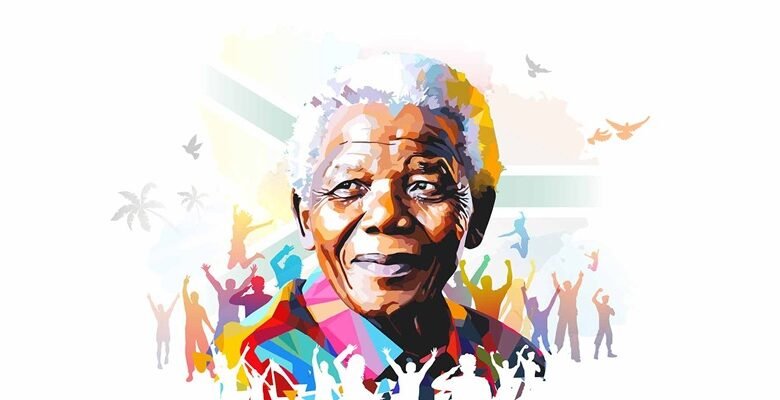
“ It is easy to break down and destroy.
The heroes are those who make peace and build.” – Nelson Mandela
Nelson Mandela endured 27 years of imprisonment due to his opposition to the apartheid regime in South Africa. He encountered severe conditions designed to undermine his determination, yet Mandela remained steadfast in his pursuit of equality for all individuals.In spite of the significant personal sacrifices associated with his incarceration, Mandela continued to serve as a leader, rallying his fellow political prisoners. Following his release, he played a crucial role in negotiating the end of apartheid and subsequently became South Africa’s first democratically elected president.
This narrative chronicles Nelson Mandela’s transformation from prisoner to president. Mandela was imprisoned for his resistance to the apartheid laws in South Africa.
The term apartheid translates to “apartness” in Afrikaans. The apartheid laws classified South Africans into four distinct racial groups: “white/European,” “black,” “coloured (individuals of mixed race),” and “Indian/Asian.” The white population, comprising 15 percent of South Africa’s populace, occupied the highest societal echelon, enjoying power and affluence. Conversely, black South Africans, who made up 80 percent of the population, were relegated to the lowest tier.
Numerous South Africans opposed apartheid through various means. Their strategies included civil disobedience campaigns, nationwide strikes, and boycotts. Nelson Mandela became involved in this resistance during the 1940s as a young attorney. By the 1950s, he had emerged as a significant figure in the fight against apartheid. The South African government reacted to the calls for equality and freedom with oppression and brutality, resorting to the shooting of unarmed protesters and the detention and arrest of many others.
Initially, the defiance against apartheid was peaceful; however, Mandela eventually concluded that armed resistance was the sole viable path forward. He and others established an armed resistance organization known as Umkhonto weSizwe (“Spear of the Nation”), commonly referred to as MK. Mandela spent 17 months in hiding, seeking to garner support for the armed struggle, but was apprehended in 1962. Subsequently, in 1963, he faced trial on multiple charges, resulting in a life sentence for him and seven of his associates.
In 1964, Mandela and his fellow compatriots were incarcerated in a maximum security facility located on Robben Island. Notably, there were no white inmates on the island. Mandela endured 18 out of his 27 years of imprisonment there, alongside other political prisoners who were housed in a distinct section. The conditions on Robben Island were severe, designed to undermine the prisoners’ determination. Rights were systematically denied based on racial distinctions. Black inmates received inferior food compared to their Indian/Asian or mixed-race counterparts. Furthermore, Black men were compelled to wear shorts and sandals, even during the winter months, while other prisoners were allowed to wear trousers and shoes. Among all, political prisoners experienced the most brutal conditions. Condemned to arduous labor, Mandela and his fellow activists spent over a decade breaking rocks in a lime quarry. Some inmates suffered assaults and torture at the hands of the guards.
Communication with the outside world was nearly entirely cut off. Upon his arrival at Robben Island, Mandela was allowed only one letter and a 30-minute visit every six months. He was denied the opportunity to attend the funeral of his mother, who died in 1968, as well as that of one of his sons, who perished in a car accident in 1969. It would take 21 years before he could embrace his wife, Winnie Mandela, once more. His two young daughters, Zeni and Zindzi, had to wait until they turned 16 to see him.
Prisoners were separated from their visitors by glass walls. They communicated via telephones while guards eavesdropped on their conversations. Letters were subjected to rigorous censorship, with any non-personal words blacked out. When prisoners discovered methods to decipher the obscured content, censors escalated their efforts by cutting out substantial portions of letters, rendering them into fragments.
Outside the walls of Mandela’s prison, South Africans continued to resist the apartheid regime. In 1985, under increasing pressure, the government made an offer to release Mandela, on condition he renounce violence as a political tool. Mandela rejected the offer. His youngest daughter, Zindzi Mandela, read his response at a mass rally in Soweto: “What freedom am I being offered while the organization of the people remains banned? What freedom am I being offered when I may be arrested on a pass offence? What freedom am I being offered to live my life as a family with my dear wife who remains in banishment in Brandfort? What freedom am I being offered when I must ask for permission to live in an urban area? What freedom am I being offered when I need a stamp in my pass to seek work? What freedom am I being offered when my very South African citizenship is not respected? […] Your freedom and mine cannot be separated. I will return.”
Mandela was dedicated to securing freedom for all South Africans, not merely for himself. In 1986, he began to discreetly engage with the South African government to ascertain their willingness to negotiate an end to apartheid.Four years later, on February 11, 1990, the most renowned political prisoner globally was released. At the age of 71, he recognized that there was still much work ahead. Following Mandela’s release, years of tense negotiations ensued. During this time, political violence and civil war loomed as significant threats to the nation.
In 1993, South Africa implemented an interim constitution, which laid the groundwork for the nation’s inaugural democratic elections. That same year, the Nobel Peace Prize was awarded jointly to Mandela and South African President F. W. de Klerk.The first democratic elections in South Africa took place in 1994. Once all votes were tallied, Nelson Mandela emerged as the nation’s first democratically elected president. He committed the remaining years of his life to the transformation of his country, consistently recognizing that there was still much to accomplish and that future generations would bear the responsibility of continuing the fight for freedom.