This nanocraft may travel 100 years to reach a black hole
News Mania Desk / Piyal Chatterjee / 9th August 2025

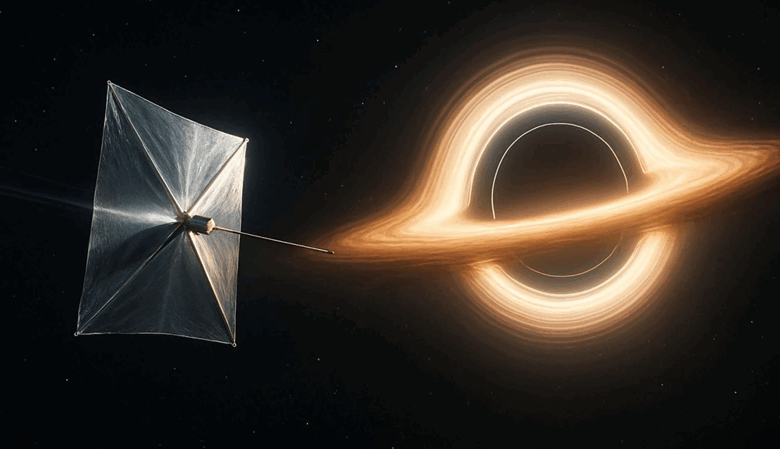
Cosimo Bambi, an astrophysicist, has put up a novel idea: using a spaceship as light as a paperclip to investigate a black hole up close. According to Bambi’s plan, which was published in the journal iScience, a nanocraft powered by strong lasers based on Earth would travel across space at a third of the speed of light in order to reach a neighboring black hole in less than a century.
Although it seems like science fiction, Bambi thinks that if laser and probe technology improve and prices decrease, such a voyage may become possible in 20 to 30 years. A microprocessor and a light sail propelled by photon beams would make up the vessel, which would only weigh a few grams.
Compared to traditional chemical propulsion, which is much too sluggish for interstellar travel, this propulsion technique would enable the spaceship to reach a possible black hole in 20 to 25 light-years.
Finding a good target black hole is important yet difficult because black holes don’t emit light and aren’t visible to conventional telescopes. Instead, by detecting light distortions or gravitational effects on neighboring stars, astronomers can deduce their presence. There is optimism that a black hole within 25 light-years of Earth might be found in the next ten years thanks to advancements in detection techniques, creating a plausible timeframe for such a bold expedition.
The nanocraft could carry out tests that could transform physics once it gets close to the black hole. In addition to testing whether the fundamental rules of physics, particularly Einstein’s general relativity, hold true in such harsh circumstances, scientists might investigate whether black holes indeed have event horizons—the points of no return where even light cannot escape. This mission’s findings might question or validate our knowledge of gravity and space-time in hitherto unattainable ways.
Bambi recognizes the high expense and technology challenges of today—laser facilities alone may cost a trillion euros. However, he makes comparisons to past discoveries that were formerly thought to be impossible, such the identification of gravitational waves and the imaging of black hole shadows decades after Einstein’s theory said they would occur.
By sending a small probe speeding across the cosmos to uncover the universe’s deepest secrets, this ambitious endeavor pushes the limits of human knowledge and embodies the adventurous spirit of astrophysics.
It predicts a time when mankind will be able to send small, light explorers to the most mysterious things in space, possibly changing the rules of physics as we know them.