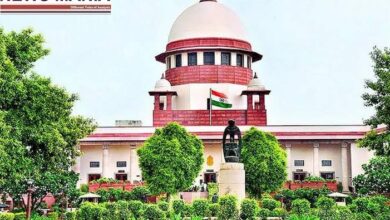
Top court recalls order barring High Court judge from hearing criminal cases
News Mania Desk / Piyal Chatterjee / 8th August 2025

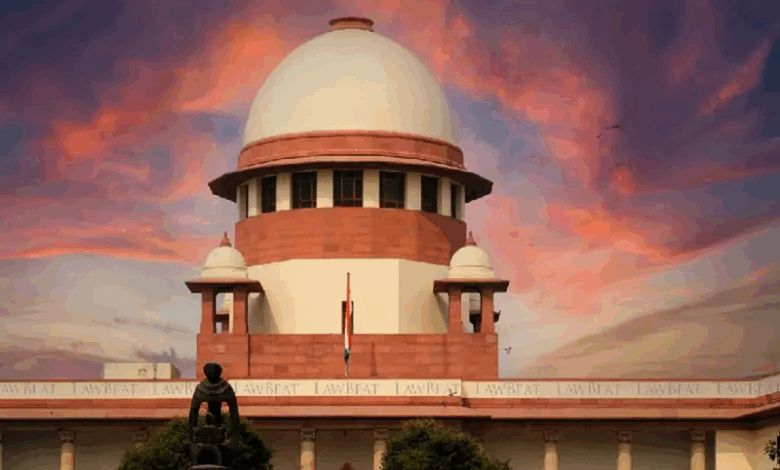
In a historic decision, the Supreme Court on Friday retracted its August 4 directive that mandated a judge from the Allahabad High Court be barred from handling criminal cases until retirement and instead required them to work alongside a senior judge.
The bench comprising Justices J B Pardiwala and R Mahadevan had given the directive after voicing concerns over an order by Justice Prashant Kumar, who declined to dismiss a criminal complaint, asserting that the existence of a civil remedy for recovering money was not adequate reason to quash the complaint
The recall came after a plea from Chief Justice of India B R Gavai, who urged the bench to reassess the restrictions placed on the High Court judge in light of broad disapproval of the init al order
“We have received an undated letter from the hon’ble Chief Justice of India requesting the reconsideration of the observations in paras…In such circumstances, we directed the Registry to re-notify the main matter for considering the request made by the Chief Justice of India,” Justice Pardiwala said while explaining the reasons for re-listing.
Additionally, thirteen High Court judges wrote to the Chief Justice of the Allahabad High Court, urging him not to implement the Supreme Court’s earlier directions.
In the fresh order, Justice Pardiwala said that there was no intention to embarrass or disparage the judge. “We must clarify that our intention was not to cause embarrassment or cast aspersions on the concerned Judge. We would not even think of doing so. However, when the matters cross a threshold and the dignity of the institution is imperilled, it becomes the constitutional responsibility of this Court to intervene even when acting under its appellate jurisdiction under Article 136 of the Constitution,” Justice Pardiwala said.
The bench clarified that the Supreme Court’s goal was to uphold the judiciary’s dignity without interfering with the administrative powers of the High Court. It stressed that High Courts are integral to the judicial system, not separate from it.
“We hereby delete paragraphs 25 and 26 of our August 4 order and leave it to the Chief Justice of the High Court to take an appropriate view,” the bench said, affirming the Chief Justice’s authority over case allocation.
Even though the previous directions were withdrawn, the bench asserted that the initial High Court ruling was “perverse” and “illegal,” indicating substantial concern regarding its rationale. It emphasized that such directives weaken public trust in the legal system and must be acknowledged .
India is one of the two nations with the highest trade tariffs set by US President Donald Trump, along with Brazil—both subjected to 50% duties on exports to the United States. Currently, India has 25% tariffs in effect, with an additional 25% tariffs, deemed a “penalty” by Trump for purchasing Russian oil, to take effect 21 days later, on August 28.
Syria ranks next at 41%, followed by Laos and Myanmar at 40%, completing the top five on the NYT’s tariff rate chart, with India being the largest economy among them. Despite clear issues with Trump’s justification, India has become a primary target of his anger, as he claims that countries importing from Russia are “fueling the war machine” against Ukraine.
Trump is scheduled to meet with Russian President Vladimir Putin in a few weeks, and the invasion of Ukraine will probably be the primary topic of discussion. An agreement there might further undermine the justification for punitive tariffs on Russian oil.
On Thursday, Prime Minister Narendra Modi had a phone conversation with Brazil’s Luiz Inacio Lula da Silva. They allegedly talked about the tariffs, among other matters.Lula has been confrontational towards Trump, while India has also consistently stated that the US decision lacks consistency in its rationale. European nations also import Russian crude oil.
Russia and China, however, have so far sided with or acknowledged the Modi government’s position as they seek to counter-balance the US in an increasingly multipolar world.
“Sovereign countries have the right to choose their own trade partners,” Russian spokesperson Dmitry Peskov has said.
The Chinese ambassador to India, Xu Feihong, apparently took a shot at Trump in a social media post on Thursday, the day the 25% first round of tariffs on India came into effect. “Give the bully an inch, he will take a mile,” Xu Feihong posted on X.
Certain analysts think tariffs are being employed as a strategy now since US trade with Russia has persisted even with the Ukraine war that began in 2022. Russia ranks as the world’s third largest crude oil producer, following the US and Saudi Arabia. India ranks as the third-largest oil consumer globally.
In 2025, EU’s oil imports from Russia decreased to 2.01% from 28.74% in 2021, yet the figure reached 1.48 billion euros in just the first quarter of 2025. Russia accounts for 17% of natural gas in the EU and nearly 8% in iron and steel. Over 25% of the EU’s fertiliser imports come from Russia. The US has not applied punitive tariffs on the EU.
India, which has neutrally advocated for a resolution to the Ukraine conflict on various platforms, has rationalized its growing imports from Russia, its longstanding strategic ally as well. It mentioned factors such as availability, pricing, and national interest .
India’s petroleum minister Hardeep Singh Puri had said last month that because price of oil would have gone up significantly, “we were advised, including by our friends in the United States, to please buy Russian oil”.
Russian oil is now 37 per cent of India’s total oil imports, according to Kpler, a data analytics firm, making India one of Russian crude’s two top buyers along with China. In the last fiscal year, India saved around $3.8 billion on its purchases on discounted prices from Russia, credit rating agencies have estimated.