
AI plush toys promise screen-free play for kids— but at what cost?
News Mania Desk / Piyal Chatterjee / 18th August 2025

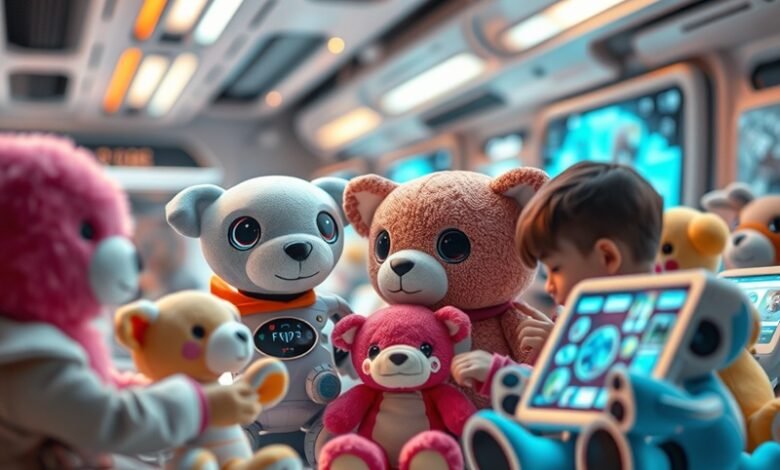
A new type of toy is being introduced to the market by the Redwood City, California-based startup Curio: chatbots disguised as stuffed animals. A Wi-Fi-enabled speech box is concealed inside each of the plush toys that its creators, Misha Sallee and Sam Eaton, have made: Grem, Grok, and Gaboo. An Artificial Intelligence (AI) language model that is intended to converse with young children is connected to the toy via this voice box.
These toys, which cost $99 apiece, are part of an increasing range of kid-targeted products that use artificial intelligence. According to Amanda Hess of the New York Times, this trend is expected to grow since OpenAI and Mattel have teamed together to create AI-powered products based on well-known brands like Barbie and Ken.
In order to appeal to busy parents who wish to keep their children away from tablets and phones, Curio markets its goods as an alternative to screen time. Eaton, a co-founder of the company, characterized the plush toys as a “sidekick” that might make kids’ play “more stimulating” and relieve parents of the need to place their kids in front of a television. But Hess questioned this assumption.
Even while kids already converse with their toys, the AI plush toys bring another level of sophistication. Hess records an odd exchange with Grem, one of the toys, during a demonstration. Despite being unable to see, Grem suggested playing “I Spy.” She also highlights how ironic it is that these toys are meant to replace screens when they function on a similar technological foundation
Concerns of privacy and parental control are also brought up by these items, in addition to the psychological effects of utilizing an AI-powered toy. For example, Curio makes sure that all of the chats with its chatbots are recorded and transmitted to the guardian’s phone. Although its privacy policy outlines all the different paths a child’s data may follow, including to the third-party businesses OpenAI and Perplexity AI, the company claims that these chats are not kept for any other purposes.
The author also raises concerns about what occurs when a child’s transitional item—like a blanket or a stuffed animal—becomes a source of monitoring and a tool of parental control rather than a place where they can freely express their thoughts.
Hess turns the plush toy back into a basic stuffed animal by taking out the voice box to wrap up her investigation. Her hypothesis that the most wonderful toys are those that don’t require a voice box at all is confirmed when her kids discover it and use it in their own creative games.