China Stages Massive Military Parade, Unveils Advanced Arsenal and Sends Geopolitical Message
News Mania Desk / Piyal Chatterjee / 4th September 2025

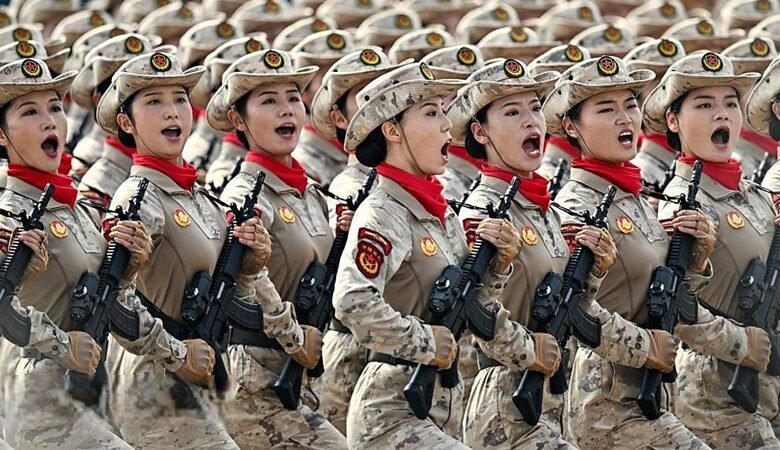
Beijing showcased its growing military might on September 3 with a spectacular parade marking the 80th anniversary of the end of World War II, unveiling advanced weapons while projecting political confidence under President Xi Jinping.
Held along Chang’an Avenue in Tiananmen Square, the event brought together more than 10,000 troops and an array of sophisticated armaments. For the first time, China displayed its complete nuclear triad—land-based intercontinental ballistic missiles, submarine-launched systems, and nuclear-capable bombers—underscoring its expanding deterrence capabilities. Among the highlights was the DF-61 mobile ICBM and the DF-5C silo-based missile, alongside hypersonic and supersonic anti-ship missiles designed to challenge naval power.
China also revealed cutting-edge directed-energy technology, introducing the LY-1 high-power laser, believed to counter aerial and maritime threats such as drones and missiles. Drones, stealth fighters like the J-35, and unmanned underwater vehicles rounded out the presentation, signaling Beijing’s push for technological dominance in modern warfare.
In his address, Xi Jinping framed the parade as both a commemoration and a statement of intent. He declared that “humanity faces a choice between peace and war,” warning against external “bullying” while reiterating China’s commitment to national rejuvenation. Analysts noted that his central role and rhetoric reinforced his image as the commander-in-chief guiding the nation toward superpower status.
Adding to the parade’s symbolism, Xi stood alongside Russian President Vladimir Putin and North Korea’s Kim Jong-un, emphasizing China’s strengthening ties with authoritarian allies. Their presence was widely interpreted as a display of solidarity in opposition to Western influence.
International observers saw the parade as more than pageantry. Analysts in Singapore, Washington, and London argued that the exhibition served as a deterrent message to the United States and its regional partners, particularly in the South China Sea and Taiwan Strait. The focus on hypersonic systems, cyber-warfare units, and autonomous technologies reflected China’s strategy to prevent foreign intervention and assert control over contested areas.
Reactions in Taiwan were sharply critical, with President Lai Ching-te condemning the display as intimidation aimed at destabilizing regional peace. Yet some Taiwanese citizens described the spectacle as a show of strength rather than an immediate threat, noting its heavy emphasis on symbolism.
The parade reaffirmed both China’s growing technological capabilities and Xi Jinping’s ambition to position the country as a dominant global power. While framed domestically as a celebration of sacrifice and victory, its broader message to the world was unmistakable: Beijing intends to defend its rise with a modernized, formidable military.