
Bend, twist, stretch: Wild octopus shows off 4,000 unique arm movements
News Mania Desk / Piyal Chatterjee / 12th September 2025

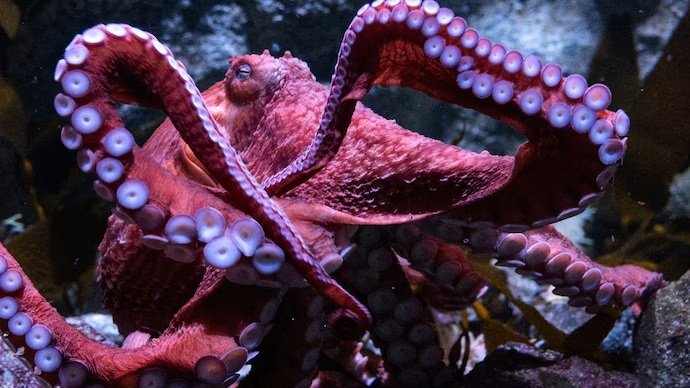
A recent study published in “Scientific Reports” has provided new insights into the flexibility and adaptability of octopus limbs. By closely observing three wild octopus species in their natural habitats across the Caribbean and Spain, researchers have recorded nearly 4,000 arm movements, highlighting adaptability and revealing that each of the eight octopus arms can perform all action types.
They found that each octopus arm has remarkable flexibility and functional specialization, able to execute all action kinds. The results demonstrate a distinct division of arm functions and emphasize the complicated behavior that octopuses employ to survive in a variety of settings, ranging from intricate coral reefs to smooth sandy seabeds. Twelve different arm motions totaling fifteen behaviors were recorded by the researchers; each action involved one or more of the four basic deformations: twisting, bending, elongating, and shortening.
Using 25 video recordings, the scientists studied octopuses in six shallow-water habitats, including sandy and extremely complicated coral reef settings.
According to analysis, octopuses mainly use their front arms for exploration, while their back arms mainly help with locomotion. Each of the four forms of arm deformations—bend, elongate, shorten, and twist—was seen in almost 7,000 reported arm deformations. Interestingly, elongations were more common in the body, while bends were more common toward the extremities, indicating a highly developed degree of regional specialization.
“When octopuses move across an open environment, they skillfully use multiple arms to stay camouflaged from predators, such as the moving rock trick or looking like floating seaweed,” said Bennice. She added, “Beyond foraging and locomotion, their arm strength and flexibility are essential for building dens, fending off predators, and competing with rival males during mating.”
“Understanding these natural behaviours not only deepens our knowledge of octopus biology but also opens exciting new avenues in fields like neuroscience, animal behaviour, and even soft robotics inspired by these remarkable creatures,” said Bennice.