Unstable Sunspot Sparks Concerns Over Potential Solar Eruption
News Mania Desk / Piyal Chatterjee / 17th October 2025

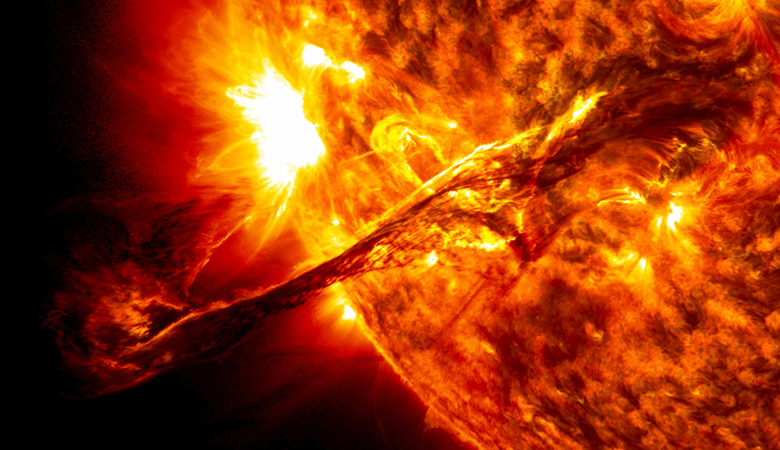
A massive and unstable sunspot on the Sun’s surface, designated AR4246, has raised alarms among space scientists due to its potential to unleash a major solar eruption. The active region, one of the largest formations in the current Solar Cycle 25, exhibits an unusually complex magnetic structure with mixed polarities — a configuration often linked to powerful solar flares and coronal mass ejections (CMEs).
According to solar observers, AR4246’s magnetic field appears highly disordered, with opposite polarities twisting and interacting in unpredictable ways. Such instability increases the likelihood of a magnetic reconnection event — a phenomenon in which magnetic field lines suddenly break and realign, releasing vast amounts of energy into space.
If a CME from AR4246 is directed toward Earth, it could disrupt satellite communications, navigation systems, and power grids, while also posing risks to astronauts and high-altitude flights. These eruptions can cause geomagnetic storms capable of interfering with radio transmissions and potentially affecting critical infrastructure on the planet.
Experts caution that while the region’s volatile behavior suggests a heightened risk, an eruption is not guaranteed. Continuous monitoring will determine whether the sunspot’s activity intensifies or stabilizes as it rotates across the Sun’s visible surface.
In contrast, a nearby sunspot named AR4248 remains comparatively stable, offering a calmer counterpoint to AR4246’s turbulence. Scientists are closely tracking both regions using solar observatories and space weather monitoring systems to anticipate any sudden flare-ups.
The emergence of AR4246 underscores the growing solar activity expected as the Sun approaches the peak of its 11-year cycle. Researchers warn that such episodes, though part of the Sun’s natural rhythm, highlight the importance of preparedness against the far-reaching effects of solar storms on Earth’s technological systems.