Trump Wraps Up ASEAN Visit, Leaves Trade Questions Hanging for Southeast Asia
News Mania Desk / Piyal Chatterjee / 27th October 2025

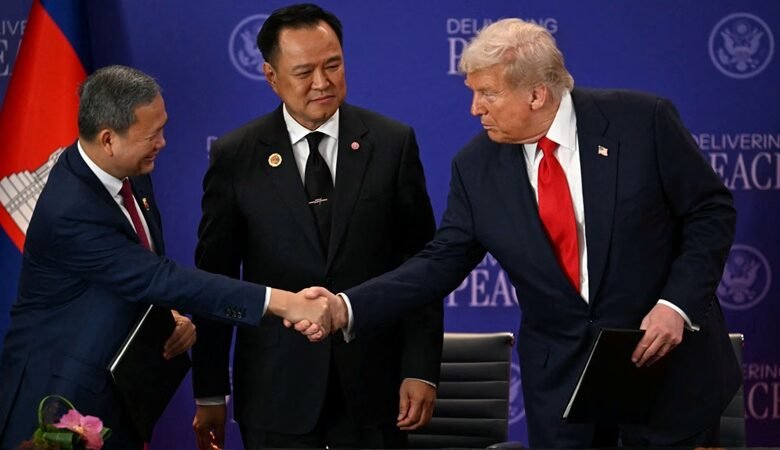
U.S. President Donald Trump concluded his visit to the 47th Association of Southeast Asian Nations (ASEAN) Summit in Malaysia on Sunday, leaving the region with a mix of optimism and uncertainty about the future of trade relations with Washington. While the trip produced several bilateral deals, many structural economic issues remained unaddressed, raising doubts about the long-term impact of Trump’s renewed focus on Southeast Asia.
During his visit, Trump presided over the signing of a series of framework trade agreements with Malaysia, Thailand, Vietnam, and Cambodia. The deals were aimed at boosting American engagement in the Indo-Pacific region and strengthening supply-chain cooperation amid intensifying competition with China. Under these agreements, the four countries agreed to lower non-tariff barriers, expand U.S. imports of agricultural products and aircraft, and collaborate on critical mineral supply chains.
Malaysia emerged as a key partner, securing zero-percent tariffs on key exports such as palm oil, rubber, and cocoa. However, analysts noted that none of the pacts qualified as full-fledged free trade agreements, with the documents offering limited legal enforceability and leaving several contentious issues unresolved.
Notably, the new accords avoided addressing rules of origin, semiconductor tariffs, and trans-shipment practices — all crucial to Southeast Asia’s manufacturing and export systems. Economists cautioned that without clarity on these matters, the region’s semiconductor and electronics industries could remain vulnerable to shifting U.S. tariff policies.
Several ASEAN members — including Indonesia and the Philippines — were left out of this phase of U.S. engagement, raising questions about Washington’s long-term strategy in the region. Analysts warned that selective partnerships could fragment ASEAN’s trade unity and limit the bloc’s ability to collectively negotiate favorable terms.
Observers also pointed out that the agreements rely heavily on Washington’s discretionary power to impose or remove tariffs, creating uncertainty for investors and exporters. While Trump described the deals as “fair and balanced,” critics argued they are more political in symbolism than practical in substance.
In contrast, China wasted no time positioning itself as a stable trade partner, with Beijing signaling a push to deepen economic ties with ASEAN following Trump’s departure. Malaysian officials, meanwhile, urged the bloc to maintain strategic neutrality and avoid being drawn into U.S.-China rivalry.
As Trump continues his Asia tour with stops in Japan and South Korea, Southeast Asian governments are left to interpret what his promises of “renewed partnership” mean in concrete terms. While some see an opportunity for deeper ties with the United States, others worry that the absence of binding commitments could leave ASEAN exposed to economic volatility and geopolitical competition.