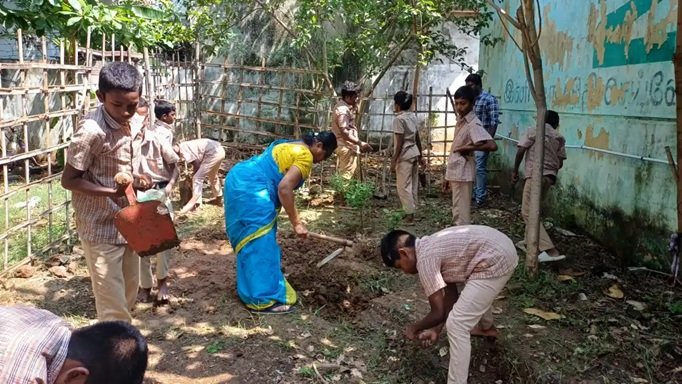
Environmental Education (EE) is crucial duscipline because it equips individuals and communities with the knowledge, skills, attitudes, and values needed to understand and address environmental challenges. EE is not just about knowledge—it’s about shaping a mindset and society that can live in harmony with the planet while ensuring its resources remain available for future generations. EE helps people understand the interconnections between humans and the environment, including issues like Climate Change, pollution, deforestation, and biodiversity loss.
Awareness is the first step toward responsible action. EE fosters a sense of responsibility, care, and respect for the environment, encouraging sustainable lifestyles and ethical decision-making. It teaches practical skills such as waste management, energy conservation, and sustainable agriculture, enabling individuals to implement eco-friendly practices. By combining knowledge and values, EE encourages behavior that reduces environmental impact, such as recycling, using renewable energy, and conserving water.
EE empowers communities to participate in environmental protection, policy-making, and conservation projects, creating a collective effort toward sustainability. It is fundamental for achieving sustainable development goals, balancing ecological integrity with economic growth and social well-being. It nurtures analytical and problem-solving skills, enabling individuals to assess environmental issues, explore solutions, and make informed choices. Teaching children and youth about the environment ensures that future generations are equipped to live sustainably and continue conservation efforts.
Challenges of Implementing Environmental Education in India
EE aims to create awareness, knowledge, and responsibility towards environmental protection. In India, though it has been integrated into school and university curricula, its implementation faces several challenges. Many teachers lack proper training and expertise in environmental issues. Without adequate knowledge or motivation, they often treat EE as an additional subject rather than a vital component of education. In India, any firm ifceducation is often textbook-based, focusing on memorization rather than practical, activity-oriented learning. This limits students’ real understanding and connection with nature. Schools, especially in rural and government sectors, often lack resources such as laboratories, green spaces, audiovisual tools, and field trip funding necessary for effective EE.
Despite being mandated by the Supreme Court of India, environmental education is often not given equal weight as core subjects like mathematics or science. It is sometimes treated as an “extra” subject. Rural students may experience nature closely but lack structured environmental education; while urban students have access to better education but limited exposure to natural environments. Parents and communities often do not recognize the importance of EE, leading to weak community participation and support for environmental initiatives in schools.
While several policies promote EE—such as the National Policy on Education (1986) and NEP 2020—their execution at ground level remains inconsistent due to bureaucratic hurdles and lack of monitoring. EE materials are often in English or Hindi, not adequately translated or localized for regional contexts and indigenous knowledge systems.
Environmental issues are complex and require integration across subjects; but our current curricula across India rarely connect EE with economics, social studies, or ethics.
Digital tools and environmental simulations are underutilized, especially in government schools that face infrastructural constraints. To overcome these challenges, India must invest in teacher training, hands-on learning, community participation, and policy monitoring. Promoting environmental values from an early age through experiential education can help nurture responsible citizens capable of addressing the environmental crises of the future.
Strategies for successful implementation of Environmental Education in India
EE should be incorporated at all levels — from primary to higher education — as part of science, social studies, and value education. Using field visits, nature camps, and eco-club projects to make learning more experiential. Teaching environmental issues relevant to local ecosystems, pollution problems, and community needs will empower students. Teachers should be trained to effectively teach environmental topics using interactive and interdisciplinary methods. Creating district-level resource centers for teacher support, materials, and updated information will be essential.
Involving parents, NGOs, and local bodies in school environmental projects like waste management or water conservation; integrated with awareness drives, eco-fairs, and clean-up events can help build strong environmental consciousness beyond classrooms. Promoting e-learning platforms, documentaries, and mobile apps for environmental awareness can be axsyring factor in motivating students towards EE. Campaigns on social media platforms like Facebook, X, YouTube, WinChat, Snapchat, Signal, Telegram, WhatsApp, Instagram etc to engage youth in environmental action through cibstructive and creativecappriach.
Encouraging joint initiatives between educational institutions, NGOs, and environmental agencies through various corporate-based CSR programs of industries for funding and supporting school eco-projects are essential tools to add fuel to the zeal of EE. Strengthening implementation of the National Environmental Education Policy (NEP) and the NEP 2020 provisions by allocation if budget for EE based programs, training, and infrastructure can further strengthen EE platform at primary, secondary and tertiary lecek if education. Including environmental knowledge and behavior-based evaluation in school assessments will help minitir the student progress. Track changes in students’ awareness, attitudes, and community participation over time call help in stronger implementation parameters at the groud level. Promotion of eco-friendly practices such as to adopt waste segregation, rainwater harvesting, and tree plantation; and developing “Green Schools” and “Sustainability Hubs” as demonstration centers can further enhance and boisterous implementation of EE across the nation.