
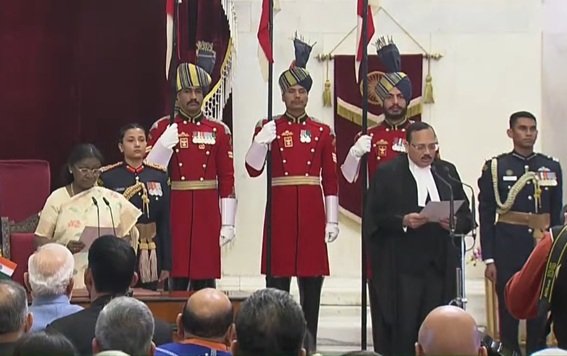
On Monday, Justice Surya Kant, who has rendered numerous significant rulings, took the oath of office as the 53rd Chief Justice of India (CJI), replacing Justice BR Gavai. Justice Kant was appointed on October 30 and will hold the position for over 15 months before retiring on February 9, 2027, when he becomes 65.
Justice Kant was sworn in at Rashtrapati Bhavan by President Droupadi Murmu. Born from a middle-class family in the Hisar region of Haryana on February 10, 1962, Justice Kant went from practicing law in a tiny village to becoming the head of the court. He excelled academically, earning a “first class first” Master of Law degree from Kurukshetra University in 2011.
Prior to being appointed to the Supreme Court, he was Chief Justice of the Himachal Pradesh High Court from October 5, 2018. He has previously written a number of important rulings in the Punjab and Haryana High Court. Significant decisions on national and constitutional matters, such as the repeal of Article 370 that eliminated Jammu and Kashmir’s special status, citizenship rights, free expression, and electoral reforms, have characterized his tenure on the Supreme Court.
As a member of the bench that stopped the colonial-era sedition statute, Justice Kant ordered the administration to stop filing fresh FIRs while they were being reviewed. Additionally, he pushed the Election Commission to reveal information about the 65 lakh voters who were left off of Bihar’s draft electoral records during the Special Intensive Revision (SIR) process.
In terms of gender justice and grassroots democracy, he ordered that one-third of seats in bar associations, such as the SCBA, be set aside for women and rehabilitated a woman sarpanch who had been wrongfully removed from office. Additionally, he continues to consider petitions from female officers seeking equity in permanent commission and was on the bench that supported the One Rank-One Pension plan for defense personnel.
Justice Kant emphasized that the state cannot claim a “free pass under the guise of national security” in high-profile investigations, such as the Pegasus spyware case. Additionally, he assisted in the appointment of a five-person panel led by Justice Indu Malhotra to look into the security lapse that occurred during Prime Minister Modi’s visit to Punjab in 2022.
Additionally, he participated in a seven-judge bench that overturned the 1967 Aligarh Muslim University ruling, allowing reconsideration of the institution’s minority status. His involvement in a presidential reference regarding the powers of the Governor and President in handling state bills underscored the potential impact of his judgments across the country.