Bangladesh’s first female prime minister Khaleda Zia dies aged 80
News Mania Desk /Piyal Chatterjee/2nd January 2026

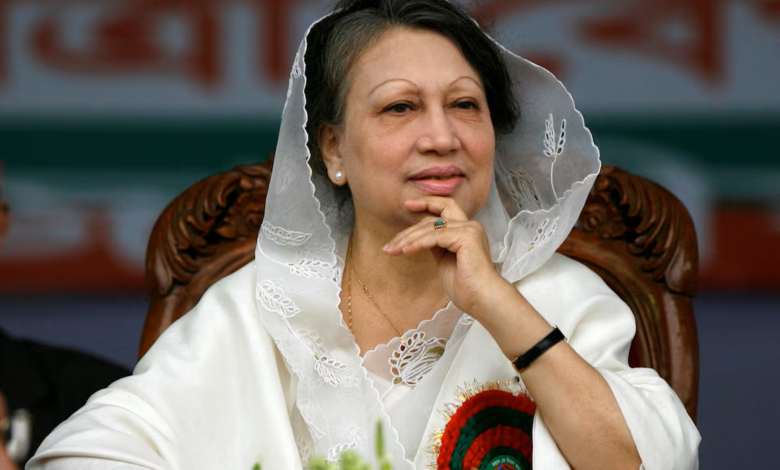
Khaleda Zia, the first female prime minister of Bangladesh, passed away at the age of 80 following a protracted illness. After guiding her party to victory in the nation’s first democratic election in 20 years, Zia became Bangladesh’s first female head of state in 1991.
Her condition was described as “extremely critical” by doctors on Monday. She was placed on life support, but due to her advanced age and general poor health, it was not feasible to administer several treatments at once, they claimed.
Her party had previously said that Zia would run in the general elections scheduled for February, the first since a revolution that resulted in the removal of Zia’s opponent, Sheikh Hasina, despite her bad health.The violent rivalry between the two women, who alternated between government and opposition, had dominated Bangladeshi politics for decades.When word of Zia’s passing spread, crowds gathered outside the Evercare Hospital ward in Dhaka. Police are seen in photos attempting to prevent them from accessing the hospital.
Zia originally gained notoriety as the spouse of Ziaur Rahman, the former president of Bangladesh, who was regarded as a quiet figure alongside her husband. Zia entered politics and eventually became the leader of the BNP after being assassinated in a military coup in 1981.
Her government restored parliamentary democracy by rewriting the constitution with bipartisan support, and her efforts to advance women’s education and social development were warmly praised during her first term.
Her brief second tenure in 1996 was criticized for holding a biased election in spite of opposition calls for an impartial caretaker government, which the parliament had agreed before to its dissolution.Zia emerged as the most well-known symbol of opposition to a government that many perceived as becoming more and more dictatorial during the previous 16 years under the Awami League.
After her opponent Hasina eliminated the caretaker government system, which was intended to maintain impartiality during national elections, she abstained from the 2014 election. Zia was later found guilty of corruption and imprisoned. She stated the accusations were politically driven and denied any misconduct.
Shortly after Hasina was overthrown by widespread anti-government demonstrations in Bangladesh and forced into exile, she was freed last year. In November, the BNP said that Zia would run for office in the next general elections.
Tarique Rahman, Zia’s son, is anticipated to take over as the nation’s leader if the BNP succeeds in regaining power. After living in self-imposed exile in London for 17 years, Rahman, 60, only returned to Bangladesh this week. For the past month, Zia has been undergoing treatment for a number of illnesses, including pneumonia, heart problems, and kidney impairment.