
Examples of stubble burning that is continuously decreasing as a result of government initiatives: Minister of Agriculture
News Mania Desk /Piyal Chatterjee/ 13th February 2026
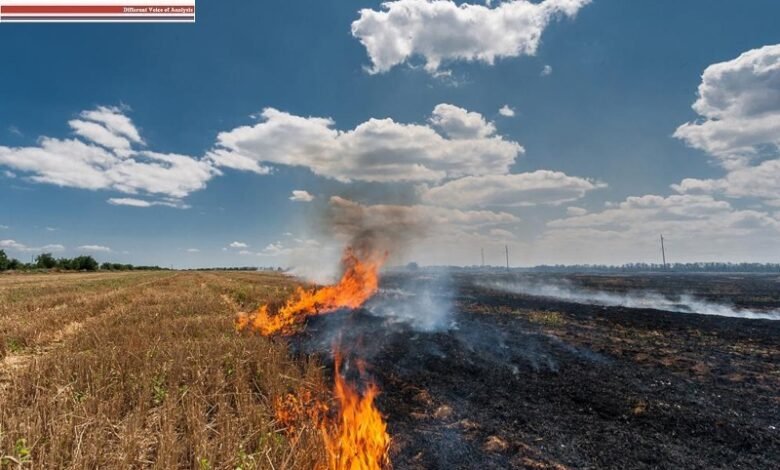
Agriculture Minister Shivraj Singh Chouhan told the Rajya Sabha on Friday that incidents of stubble burning have been gradually decreasing since the introduction of the Crop Residue Management Scheme, which provides farmers with machines at discounted prices, particularly in states like Punjab and Haryana. Since scientific studies have shown that stubble burning contributes no more than 5% to pollution in the Delhi-NCR region, even during the winter, Chouhan argued that it is not the only source of pollution.Farmers are frequently held accountable for pollution, he continued, even though industrial facilities and automobiles are among the other main causes.
The agricultural minister gave an explanation of the rationale behind the introduction of the Crop Residue Management Scheme, stating that while stubble burning is a simple method for farmers to prepare their fields for the following crop planting, it has a number of drawbacks in addition to producing pollution.
These include a decline in soil fertility, the loss of nutrients and organic carbon, and the annihilation of insects that are beneficial to crops. According to him, the government implemented the Crop Residue Management Scheme for this reason. According to Chouhan, who introduced the program, farmers who buy machinery for managing their stubble will receive a 50% subsidy. An 80% subsidy is available to organizations who establish centers to rent these machines to farmers.
Under the CRM initiative, more than 3.5 lakh farmers have received equipment, including 1,60,296 in Punjab, 1,10,550 in Haryana, and 76,135 in Uttar Pradesh. Chouhan noted that states like Punjab and Haryana have seen a sharp decrease in stubble burning incidents as a result of these initiatives. He acknowledged, though, that Uttar Pradesh has only seen a 17% decrease in stubble burning incidents, and the administration is working harder to change that.
He responded to inquiries about the 2024–2025 drop in pulse production by saying that the government is collaborating with agricultural scientists to create high-quality seeds for increased crop yields because there is a scarcity of high-quality seeds and many farmers still use traditional varieties.
He acknowledged, though, that Uttar Pradesh has only seen a 17% decrease in stubble burning incidents, and the administration is working harder to change that.He responded to inquiries about the 2024–2025 drop in pulse production by saying that the government is collaborating with agricultural scientists to create high-quality seeds for increased crop yields because there is a scarcity of high-quality seeds and many farmers still use traditional varieties.Extreme weather has an effect on crop productivity as well, he added.
Chouhan claims that the production of pulses has grown over time. He claimed that even though India was the biggest importer of pulses in 2016, the nation also saw a “Dalhan Revolution” in terms of better seed types and farmer amenities.
“It was only during 2024–25 that pulses production recorded a decline,” he said, adding that the government has launched the Dalhan Mission , which includes initiatives such as the development of improved seed varieties and the replacement of traditional seeds, among many others.
In response to a question concerning Madhya Pradesh’s moong output, Chouhan stated that the state currently produces more than 20 lakh metric tonnes of moong annually, even during the heat.