Guards practice in the Strait of Hormuz while Iran’s FM meets with the US in Geneva
News Mania Desk /Piyal Chatterjee/ 16th February 2026
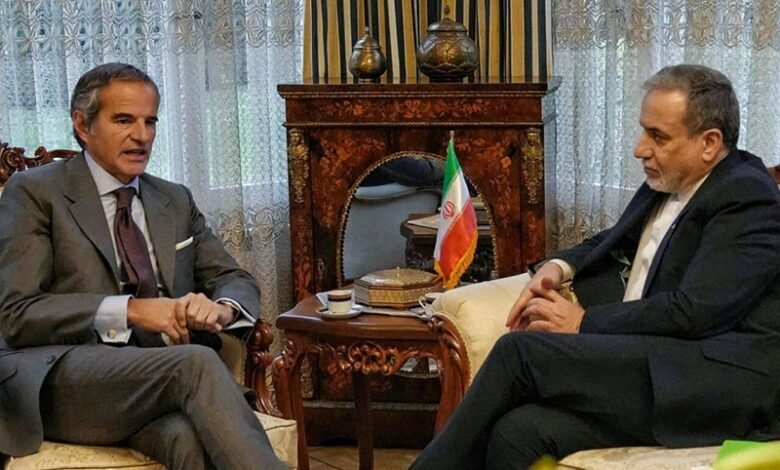
In an effort to ease tensions and prevent a new military clash that Iran’s Supreme Leader Ayatollah Ali Khamenei has warned may escalate into a regional conflict, Iranian Foreign Minister Abbas Araghchi has arrived in Geneva for a crucial second round of nuclear negotiations with the United States. As mediators attempt to avert war, the US sends warships, including a second aircraft carrier, to the region, and Iran and the US reopened talks early this month to address their decades-old disagreement over Tehran’s nuclear program.
After stating that his group of nuclear specialists anticipated a “deep technical discussion,” Araghchi met with Rafael Grossi, the director of the International Atomic Energy Agency (IAEA), on Monday.
Access to Iran’s primary nuclear facilities, which were bombarded by the US and Israel during the 12-day war in June, has been demanded by the UN nuclear inspectors. The extraordinary task of assessing highly enriched uranium supposedly buried under the rubble requires an established methodology because Tehran has stated that there may be a radiation risk.
Addressing state-run IRNEsmail Baghaei, a spokesperson for the foreign ministry, told a news agency on Monday that the IAEA will be “an important role” in the next round of mediated negotiations between the United States and Iran. He did, however, reiterate Tehran’s condemnation of Grossi for failing to denounce military attacks on Iranian nuclear sites that are safeguarded by the Non-Proliferation Treaty (NPT) by agency safeguards.
Additionally, Araghchi announced that he would meet with Badr bin Hamad al-Busaidi, his Omani counterpart, who earlier this month mediated the first round of negotiations between the US and Iran since the war.
Iran views its missile program as a “red line” that cannot be negotiated, and it has made it clear time and time again that it would not accede to Washington’s demand for zero nuclear enrichment. With President Donald Trump declaring that a change of leadership in Iran “would be the best thing that could happen” and deploying a second aircraft carrier, the US is continuing to increase its military presence in the area.The elite Islamic Revolutionary Guard Corps (IRGC) launched a series of military drills in the Strait of Hormuz on Monday, according to Iran’s state media.
Trump is expected to send his son-in-law Jared Kushner and special envoy Steve Witkoff to the Geneva negotiations on behalf of the White House. During the February 6 negotiations in Muscat, Brad Cooper, the highest ranking US military officer in the area, had unexpectedly joined the US team.
The negotiations also take place more than a month after Iran’s fatal crackdown on rallies across the country, during which Iranian officials said the unrest was caused by “terrorists” and “rioters” who were armed and supported by the US and Israel.The extensive use of deadly force against nonviolent protesters, which killed thousands, primarily on the evenings of January 8 and 9, has been attributed by the UN and international human rights organizations to Iranian authorities.
As part of any nuclear agreement with Tehran, Israeli Prime Minister Benjamin Netanyahu believes the United States must demand that Iran give up all of its enriched uranium and be prohibited from enriching any more.
“All enriched material has to leave Iran” and “there should be no enrichment capability” are two of the requirements he listed in a speech he gave on Sunday in Jerusalem. He made these remarks as US and Iranian officials get ready for a second round of negotiations in Switzerland on Tuesday. Majid Takht-Ravanchi, Iran’s deputy foreign minister, told the BBC in Tehran that if the United States is open to discussing easing sanctions, Iran will look at compromises to reach a nuclear agreement.
However, Iran believes that zero enrichment violates its rights under the nuclear non-proliferation pact and is a red line. By sending two aircraft carriers, including its largest-ever warship, to the Middle East, the US has increased its military might there and put pressure on Iran to make a deal.
At a press conference in Slovakia, US Secretary of State Marco Rubio stated that more American naval forces will guard against any possible threats in the area. Donald Trump, he claimed, “prefers diplomacy and an outcome of negotiated settlement” over attacking Iran directly.
Trump’s son-in-law Jared Kushner and top envoy Steve Witkoff are scheduled to meet with Iranian negotiators, including Abbas Araghchi, the foreign minister, who is now in Geneva.Iran agreed to restrict its nuclear operations and permit international inspections in exchange for the removal of punishing economic sanctions under the 2015 nuclear deal, from which Trump withdrew.
Takht-Ravanchi told ahead of the most recent round of negotiations that Tehran had demonstrated its willingness to make concessions by offering to dilute its 60%-enriched uranium. Although the Islamic Republic has always denied it, the presence of highly enriched uranium at levels close to weapons-grade has increased concerns that it is developing a nuclear bomb. “We are ready to discuss this and other issues related to our programme if they are ready to talk about sanctions,” Takht-Ravanchi told.