

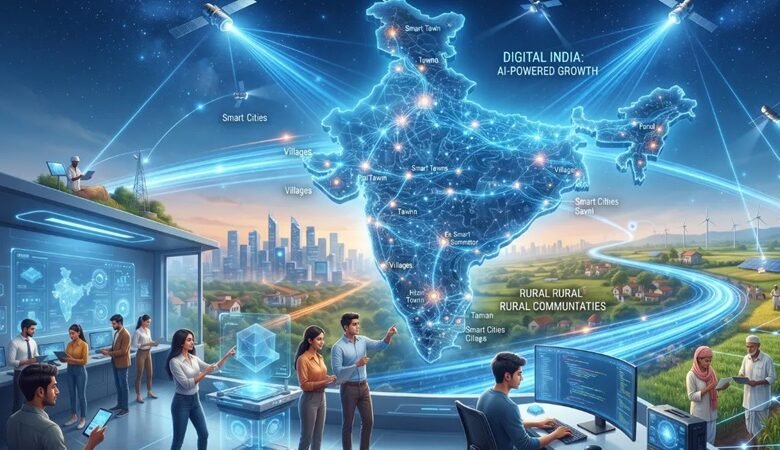
India has set an ambitious national vision of becoming a Viksit Bharat, or developed India, by 2047, the centenary year of its independence. This vision encompasses not only economic prosperity but also social inclusion, technological advancement, environmental sustainability, quality education, accessible healthcare, and good governance. Among the transformative technologies that can accelerate this journey, Artificial Intelligence (AI) has emerged as one of the most powerful. If developed and deployed responsibly, AI can become a major catalyst for India’s inclusive and sustainable development.
One of the most important contributions of AI will be in education and human resource development. AI-powered learning platforms can provide personalised education according to the needs, abilities, and learning pace of individual students. Intelligent tutoring systems can support students in remote and underserved regions, while multilingual AI tools can reduce language barriers and make quality educational resources accessible to a wider population. AI can also help teachers analyse learning outcomes and identify students who require additional support. This can contribute to building a skilled and knowledge-driven workforce for the future.
In healthcare, AI can revolutionise diagnosis, disease prediction, drug discovery, and patient management. AI-assisted medical imaging can help detect diseases at an early stage, while predictive analytics can identify health risks and support preventive healthcare. In rural India, AI-enabled telemedicine and digital health platforms can connect patients with specialists even when healthcare infrastructure is limited. However, human doctors and ethical oversight must remain central to medical decision-making.
AI can also transform agriculture, which remains vital to India’s economy and rural society. AI-based systems can analyse weather patterns, soil conditions, crop health, and market trends to provide farmers with timely information. Drones, satellite imagery, and machine learning can assist in detecting pests, managing irrigation, and improving crop productivity. AI can further support precision agriculture, reduce resource wastage, and strengthen food security while promoting climate-resilient farming.
The technology has immense potential in manufacturing and economic growth. Smart factories powered by AI, robotics, and automation can improve productivity, quality, and global competitiveness. Small and medium enterprises can use AI for market analysis, logistics, customer service, and financial management. By integrating AI with India’s digital infrastructure and entrepreneurial ecosystem, the country can generate new industries, innovative start-ups, and high-value employment opportunities.
AI can strengthen governance and public services by enabling faster data analysis, efficient delivery of welfare schemes, intelligent traffic management, disaster prediction, and better urban planning. In environmental management, AI can monitor forests, wildlife, air and water quality, biodiversity, and climate-related risks. It can therefore support India’s commitment to sustainable development and ecological security.
However, the AI revolution also presents challenges. Job displacement, algorithmic bias, misinformation, data privacy, cyber threats, and unequal access to technology must be addressed. India needs strong ethical frameworks, responsible AI policies, digital literacy, data protection, and continuous reskilling of workers. AI should complement human intelligence rather than replace human dignity, creativity, and judgement.
In conclusion, AI can play a transformative role in India’s journey towards Viksit Bharat@2047. Its greatest value will not lie merely in automation or technological sophistication, but in its ability to improve the lives of ordinary citizens. By combining AI with India’s demographic strength, scientific capabilities, entrepreneurial spirit, and commitment to inclusive development, the nation can build a future that is prosperous, innovative, equitable, sustainable, and human-centred. The responsible use of AI can thus become a cornerstone of India’s aspiration to emerge as a developed nation by 2047.