NASA Sent 3,301 Bees Into Space in 1984 to Study Honeycomb Building Without Gravity
News Mania Desk/ Piyal Chatterjee/ 28th August 2026

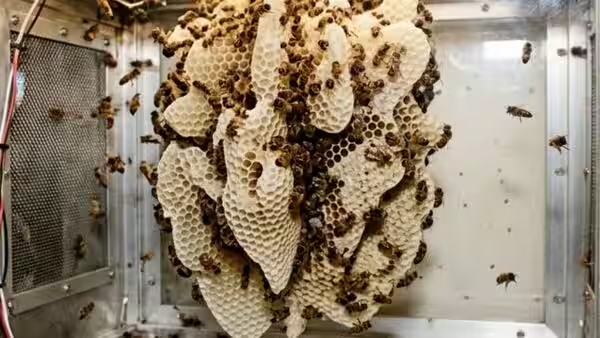
In one of NASA’s more unusual space experiments, 3,301 honeybees were sent aboard the Space Shuttle Discovery in 1984 to study how the insects behaved and built honeycomb in microgravity. The seven-day mission offered scientists an opportunity to examine whether bees could perform one of their most important natural activities without the gravitational cues they experience on Earth.
The experiment was conducted during the STS-51A mission, which launched in November 1984. The bees were kept inside a specially designed habitat that provided food and controlled conditions during the flight. Researchers were particularly interested in determining how the insects would orient themselves and whether they could construct the characteristic hexagonal structure of a honeycomb without gravity helping them maintain their position.
The bees initially struggled to adapt to the unfamiliar environment. Instead of moving in the coordinated manner normally seen on Earth, many repeatedly bumped into the walls of their enclosure. The absence of gravity made it difficult for them to determine which direction was up or down, forcing the insects to adjust their normal flying and movement patterns.
As the mission continued, however, the bees gradually became accustomed to the weightless surroundings. Their flight patterns became more controlled, and they began behaving more like they would under normal conditions. This adaptation was particularly significant because it demonstrated the ability of insects to modify their behaviour in response to an entirely different physical environment.
One of the most remarkable outcomes involved the construction of honeycomb. Despite the initial difficulties, the bees eventually began producing wax and building their comb. By the end of the seven-day experiment, they had constructed approximately 200 centimetres of honeycomb.
The experiment provided scientists with valuable information about the role of gravity in animal behaviour and architectural processes. Honeycomb construction requires bees to coordinate movement, wax production and spatial organisation, making it an interesting model for studying how biological systems function when familiar environmental cues are removed.
The 1984 experiment remains a notable example of NASA’s efforts to use spaceflight to investigate fundamental biological questions. Beyond its novelty, the study showed that honeybees could eventually adapt to microgravity and carry out complex collective behaviour, offering researchers a better understanding of how living organisms respond to the challenges of space.