
The Indonesian Forestry Ministry is prepared to return five orangutan babies who were discovered in India.
News Mania Desk/ Piyal Chatterjee/ 16th September 2026

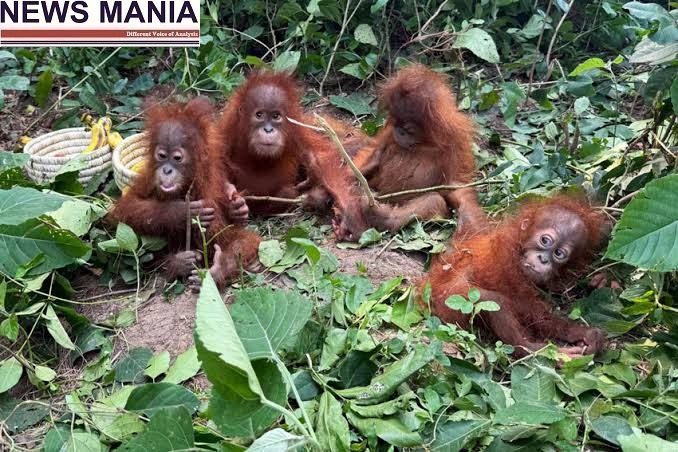
After receiving treatment, the government is making significant efforts to return five orangutan kids that were discovered in an Indian forest. Ristiano Pribadi, head of the Forestry government’s public relations and foreign cooperation office, stated that the government was closely monitoring the finds of five orangutans in the Indian state of Odisha’s Balasore area.
“The Indonesian government has coordinated with related authorities in India and at home to ensure the handling and verification of origin, and try to repatriate them to Indonesia,” he said on Thursday.
The local forestry agency found the orangutan babies on Sept. 8 in Bhogarai Block in Jaleswar range, which is near the border with the Indian state of West Bengal. “Based on initial information, the orangutan babies are aged between one and five years old and were found in healthy conditions,” Ristianto said. “Currently, all orangutans are placed and treated at the Nandankan Zoological Park in Bhubaneswar.”
Five orangutan babies found in India are preliminarily identified as originating from Sumatra, although genetic confirmation will be conducted via DNA testing. Not native to India, their presence raises concerns of involvement in illegal animal trafficking. The Indonesian Forestry Ministry is collaborating with various international and local authorities, including CITES, to expedite repatriation and ensure compliance with laws. Additionally, they are working with conservation partners experienced in the rescue and rehabilitation of orangutans.
The partners have stated that they are prepared to assist the Forestry Ministry with the five orangutan babies’ handling and rehabilitation after their return. Following their return home, the orangutans will be treated in accordance with current conservation protocols, which include health examinations, quarantine, genetic identification, behaviour evaluation, and rehabilitation based on the needs and condition of each individual orangutan.
The orangutans will be evaluated for rehabilitation and returned to their natural environment if they fulfilll the requirements. The five orangutan babies’ safety and well-being are the top priorities, along with making sure their return is handled cautiously, methodically, and in compliance with current laws.
The case demonstrates that attempts to safeguard wildlife animals cannot be carried out by a single nation. Smuggling and dealing in wildlife animals are global crimes that require close international collaboration.
There are three different species of orangutans in Indonesia. The Sumatran orangutan (Pongo abelii) is found throughout Sumatra Island, while the more restricted Tapanuli orangutan (Pongo tapanuliensis) is found only in Batang Toru, South Tapanuli regency, and its population has been severely impacted by recent flooding. The Kalimantan orangutan (Pongo pygmaeus) inhabits Kalimantan Island.
The orangutan is categorized as critically endangered on the International Union for Conservation of Nature’s (IUCN) Red List. They are legally protected from capture, harm or killing in both Malaysia and Indonesia. Orangutans also are listed under Appendix I by CITES, which prohibits their unlicensed trade under international law.