Supreme Court Says Protest Sites Cannot Be Occupied Indefinitely, Calls for Balance Between Rights
News Mania Desk/ Piyal Chatterjee/ 3rd November 2026

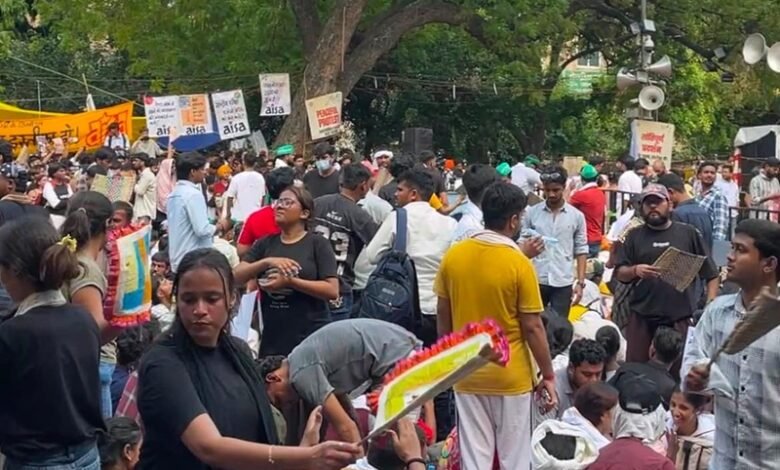
The Supreme Court of India on Tuesday said that no individual or organisation can occupy a designated protest site indefinitely, stressing that demonstrations must be permitted for a fixed duration. The observation came during a hearing on petitions relating to the large-scale protests in Delhi against Chief Election Commissioner Gyanesh Kumar and the Election Commission of India (ECI) held last month at Jantar Mantar.
A bench headed by Chief Justice of India Surya Kant, along with Justices Joymalya Bagchi and V Mohana, observed that allowing one group to occupy a public space permanently would deprive others of their opportunity to raise grievances. The court emphasised that designated protest venues should be made available to different groups for specific periods, with clear conditions governing their use.
The bench pointed out that the right to peaceful protest is constitutionally recognised, but it must be balanced against other citizens’ rights, including the right to conduct business and earn a livelihood. It said that permission granted for demonstrations should clearly specify the duration and conditions of the protest, ensuring that public spaces remain accessible to everyone.
The observations followed a petition filed by the Kirana Committee Delhi and other traders’ associations, which alleged that prolonged demonstrations in the national capital had severely affected commercial activities. Representing the traders, senior advocate Mukul Rohatgi highlighted the financial difficulties faced by shopkeepers, small businesses, daily-wage workers and transport operators due to repeated disruptions.
The traders argued that demonstrations near major commercial areas, particularly around Connaught Place and Ramlila Maidan, had affected business operations, including during the festive season. However, the Supreme Court cautioned against viewing the matter as a dispute in which one side must surrender its rights. It described the situation as a conflict between the right to protest and the right to trade and livelihood, emphasising the need for arrangements that protect both interests.
Solicitor General Tushar Mehta, appearing for the Centre and Delhi Police, told the court that permission for the July 20 demonstration had initially been granted for just one day. However, protesters allegedly continued occupying the site for 17 days and subsequently announced a march towards Parliament without authorisation. He argued that organisers must accept responsibility for the consequences of their demonstrations.
The hearing also covered allegations of police excesses, mass detentions, internet restrictions, metro station closures and the use of facial recognition technology to monitor protesters. The court asked the traders’ representatives to provide an assessment of their financial losses and directed them to include the organisations that organised the demonstrations in the proceedings.
The Supreme Court is examining several connected petitions, including challenges to the removal of Jantar Mantar’s designated protest-site status and the relocation of demonstrations to other venues in Delhi. The proceedings seek to address the broader question of protecting constitutional rights, maintaining public order and ensuring that protests do not disrupt the livelihoods of other citizens.