Aditya-L1 Uncovers New Details About Solar Eruptions, Could Improve Space Weather Forecasting
News Mania Desk/ Piyal Chatterjee/ 6th November 2026

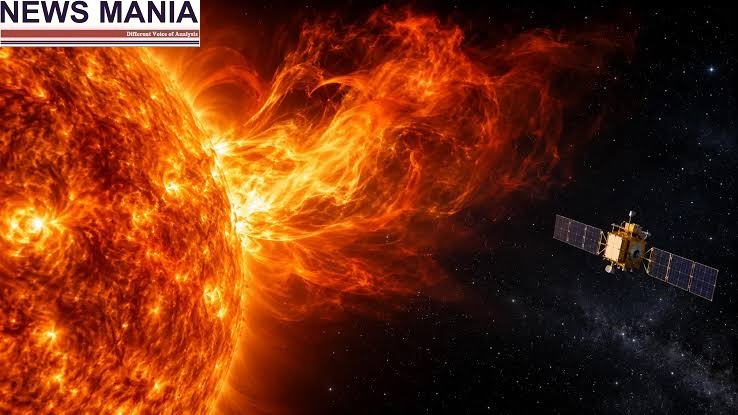
India’s first space-based solar observatory, Aditya-L1, has provided fresh insights into how powerful solar eruptions expand and travel through space, potentially helping scientists improve space weather forecasting. Researchers have discovered that these eruptions do not always expand uniformly, challenging the conventional understanding that they generally spread out like symmetrical bubbles.
The study, conducted by scientists from the Indian Institute of Astrophysics (IIA), examined a Coronal Mass Ejection (CME) that occurred on August 5, 2024, near the western edge of the Sun. Researchers combined observations from Aditya-L1’s Visible Emission Line Coronagraph (VELC) instrument with data collected by NASA’s Solar Dynamics Observatory (SDO) to investigate the eruption’s structure and movement.
Using three-dimensional computer modelling, the team reconstructed the CME’s shape and expansion as it moved away from the Sun. Their analysis revealed that the eruption expanded unevenly in different directions and followed an inclined orientation rather than maintaining a perfectly symmetrical structure.
The findings are significant because the shape and expansion of a Coronal Mass Ejection can influence how it interacts with the solar wind and travels through interplanetary space. Such variations may affect the speed and time at which these solar eruptions reach Earth, making accurate predictions more challenging.
CMEs are massive releases of plasma and magnetic fields from the Sun. When directed towards Earth, they can trigger geomagnetic storms capable of disrupting satellites, communication networks, navigation systems and power infrastructure. The research could therefore contribute to developing more reliable models for predicting solar storms and assessing their potential effects on technological systems.
The findings were published in The Astrophysical Journal Letters on November 3, 2026. The study also highlights the growing scientific importance of India’s Aditya-L1 mission, which is designed to observe the Sun continuously and investigate its complex activities.
By providing detailed information about the three-dimensional structure of solar eruptions, Aditya-L1 is helping scientists improve their understanding of solar activity and strengthen preparations against potentially disruptive space weather events.