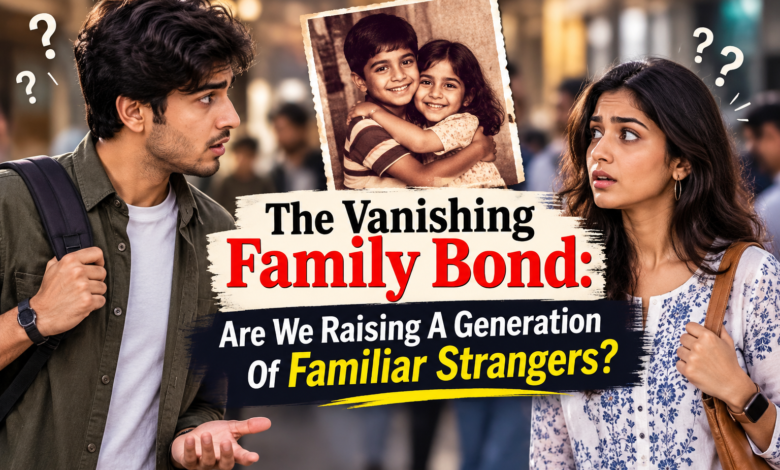
The Vanishing Family Bond: Are We Raising A Generation Of Familiar Strangers?
By Ms.Bornali Biswas –Editor in Chief - 10th November 2026

There was a time when a family meant much more than parents and children living under one roof. It meant grandparents narrating stories, cousins growing up like siblings, uncles and aunts sharing responsibilities, and family gatherings filled with laughter, arguments and countless memories. Today, that picture is gradually fading, raising a serious question: Are we slowly turning our own relatives into strangers?
The transition from joint families to nuclear households is not merely a change in living arrangements; it reflects a fundamental transformation in human relationships. Smaller families, declining birth rates, migration for employment and the growing pressures of urban life have reduced opportunities for children to develop close bonds with their extended families. Many children today have no siblings, hardly meet their cousins and may barely recognise relatives beyond their immediate household.
Technology, ironically, has made this emotional distance more complicated. We can instantly view a relative’s photographs, exchange greetings and send birthday wishes, yet meaningful conversations and personal connections are increasingly becoming rare. Digital connectivity cannot always replace the warmth of physical presence, shared experiences and emotional support.
The greatest concern is not simply that family gatherings are disappearing. It is that the next generation may grow up without understanding the importance of relationships beyond their immediate surroundings. Grandparents’ experiences, family histories, cultural traditions and the values passed down through generations risk being lost in the process.
Of course, joint families were not without conflicts, and nuclear families offer privacy, independence and freedom. The answer is not to reverse social progress but to preserve the emotional strength of family relationships.
Parents must consciously encourage children to know their cousins, respect elders, visit relatives and participate in family traditions. Family reunions, shared celebrations and even regular conversations can make a meaningful difference. Technology should become a bridge, not a substitute for human connection.
A family tree should not merely survive as names and photographs in an album; it should flourish through relationships, memories and belonging.
Perhaps the most painful legacy we could leave behind is a generation surrounded by digital connections but deprived of genuine human bonds. After all, when relatives become strangers, we lose more than relationships—we lose a part of our collective identity.It is time to reconnect before the meaning of family becomes just another forgotten tradition.
Isn’t it heartbreaking that two children who could have grown up as friends and siblings are now compelled to introduce themselves as strangers simply because family connections were never nurtured?