A 544-Page Book And A Debate Reduced To One Tear
By Rajesh Kumar Singh

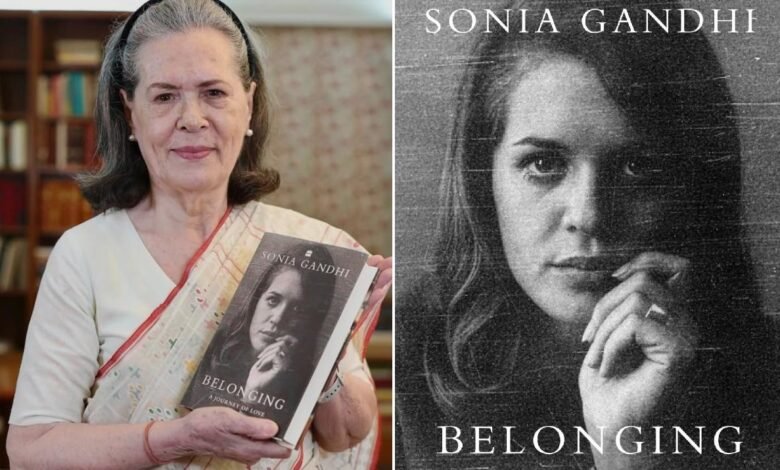
New Delhi- A book of 544 pages. The story of a wife, a mother, a daughter-in-law, and then of a woman whom this country never fully accepted as its own, and yet she made this country her hom
Sonia Gandhi’s book tells the story of her most beautiful moments with Rajiv Gandhi, to the most painful shock of his assassination. It is the story of a girl who came from Italy, who did not know Hindi, who did not know the politics of this country, but whom love connected to this land. And then one day, the assassination of that very love left her alone.
It speaks of the life after that. Raising two small children, living in the shadow of her mother-in-law, and building her own identity in a country where at every step she was called a ‘foreigner’. This book is not the autobiography of a leader, it is the diary of a woman’s struggle.
But the country is not discussing all those stories in the book. The discussion is only about that one episode, when Sonia Gandhi broke down in tears after the demolition of the Babri Masjid.
The BJP is raising questions over this issue. The question being asked is – why did she cry? For whom did she cry?
This question itself is the most painful truth of this country’s politics.
The interesting fact is that even BJP stalwarts Lal Krishna Advani and former Prime Minister Atal Bihari Vajpayee had expressed their anguish over the Babri demolition. Both had expressed their pain over the incident in separate TV interviews. Advani ji had said that he felt the deepest sorrow that day. Vajpayee ji had also called it his greatest pain.
Then why did a woman’s crying become politics? Why did a leader’s grief become history, and a wife, a mother’s tear become a question?
Perhaps because in politics, it is easier to play politics over selected pages than to read an entire book. All the ups and downs of a 544-page life were left behind, and the debate shrank to those tears shed after the Babri demolition.
We forgot that these tears were not for a Hindu or a Muslim, these tears were of an Indian. Of a woman who had lost her husband in this country, who had seen how hatred one day turns into violence. Who had seen the 1984 riots, who had seen her husband’s assassination – for her, that scene in Ayodhya was not a scene of one religion, it was a scene of humanity breaking apart.
Crying is not weakness. Crying is proof that the human inside a person is still alive. When a politician cries, we call him sensitive. But when a woman cries, we start asking about the religion of her tears.
Do not read this book through the lens of politics. Read it through the eyes of a human being. Through the eyes of a girl who crossed seven seas for love at the age of 19, and then at the age of 46, widowed, rejected the most powerful chair in this country. Who said – “My inner voice does not allow me.”
If there is even one tear in 544 pages, do not make it an issue of debate. Try to understand it. Because the day we stop questioning someone’s tears, only then will we truly become a great nation.Books are not written for politics, they are written to connect one human being to another.r the criticism.