NEW DELHI, 31 March: The National Institute of Indian Medical Heritage (NIIMH) preserves over a millennium of India’s medical legacy through rare manuscripts and artefacts, offering a vivid insight into the evolution of the country’s healthcare traditions, a top official said.
The Hyderabad-based national institute houses more than 900 medico-historical artifacts, some dating back nearly 1,000 years. These medico-historical artifacts include handwritten manuscripts on palm leaves, paper, bark, cloth, and even metal plates—materials that reflect the diverse methods used to record medical knowledge across centuries.
Under the ambitious Showcase of Ayurvedic Historical Imprints (SAHI) 2.0 initiative, NIIMH is expanding its preservation and digitisation efforts. The SAHI portal, developed by the Central Council for Research in Ayurvedic Sciences, presents a comprehensive timeline of Ayurveda—from prehistoric origins to contemporary practices—while also highlighting India’s historical medical exchanges with the rest of the world.
Prataprao Jadhav, Union Minister of State (Independent Charge) for Ayush, emphasised the significance of such efforts.
“India’s medical heritage is not merely a matter of pride, but a living continuum of knowledge,” Jadhav said.
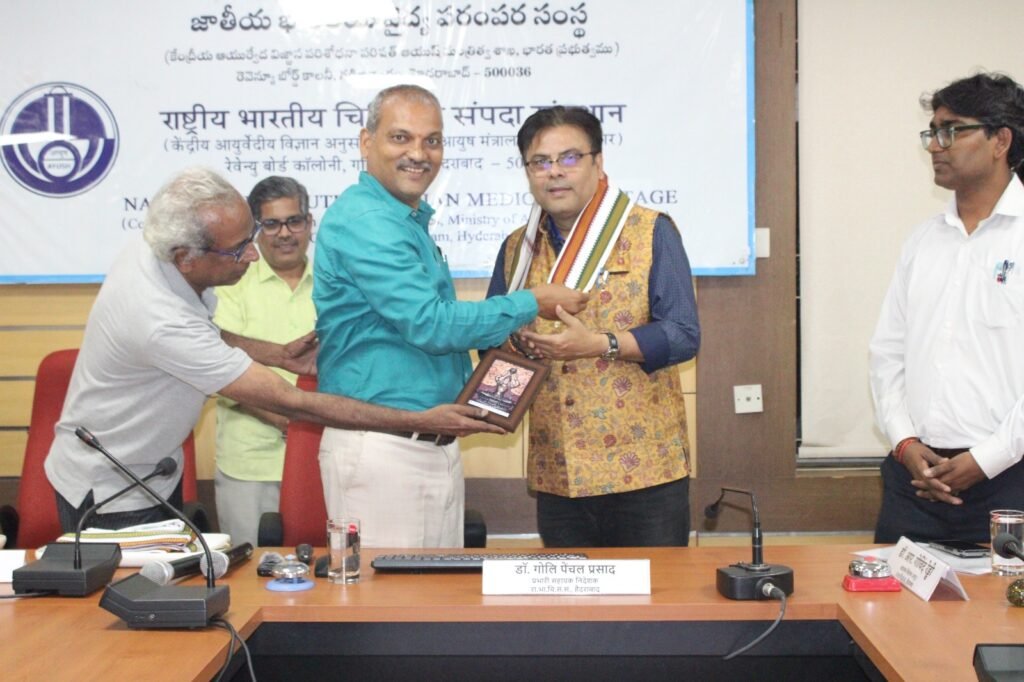
“A manuscript is a handwritten composition on various materials such as paper, bark, cloth, metal or palm leaf.,” said Dr. Goli Penchala Prasad, Assistant Director and Principal Investigator of the SAHI project.
Prasad said these were often found in temples, monasteries, and even family collections of traditional practitioners.
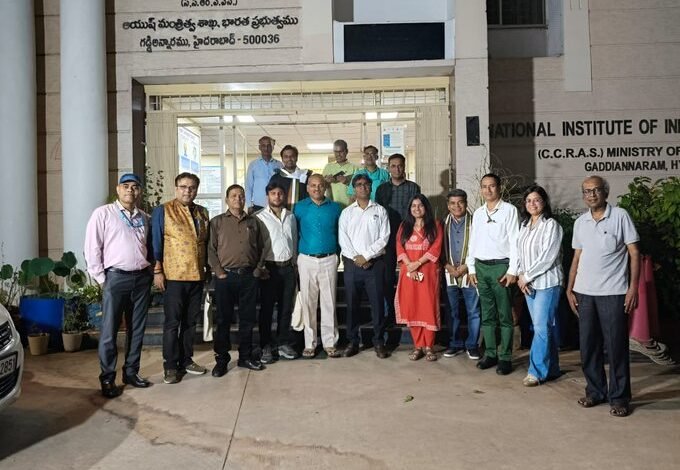
“From a historian’s perspective, SAHI aims to critically reconstruct India’s medical past and situate it within the broader context of civilisation,” Prasad told a Delhi-based media team that visited the national institute on March 23.
The SAHI project also involves locating inscriptions referenced in earlier works of the Archaeological Survey of India and digitising them for research and public access.
Among notable findings is a 1,660-year-old copper plate inscription from the reign of King Vikramaditya I of the Chalukya dynasty, discovered in present-day Andhra Pradesh, indicating that physicians once held special administrative powers. This finding has been digitised like other notable findings,
Historical references also point to renowned physician Jivaka, who served Lord Buddha and King Bimbisara, underscoring the deep roots of organised medical practice in India.
“Preservation initiatives like SAHI 2.0 will make this legacy accessible globally and help integrate traditional wisdom with modern healthcare,” the minister said.
The origins of NIIMH trace back to recommendations of the 1944 Bhore Committee, which proposed establishing an institute dedicated to the history of medicine.
The department was first set up in 1956 at Andhra Medical College, Visakhapatnam, before shifting to Hyderabad. Over decades, it evolved under various bodies, including the Indian Council of Medical Research, and was eventually upgraded in 2009 to its present status.
Today, NIIMH houses over 10,000 books, 285 manuscripts, and a specialised medico-historical museum—making it one of India’s most significant repositories of medical heritage.