A fresh chokepoint in the digital world? How India’s internet could be affected by the Strait of Hormuz crisis
News Mania Desk / Piyal Chatterjee/ 10th March 2026
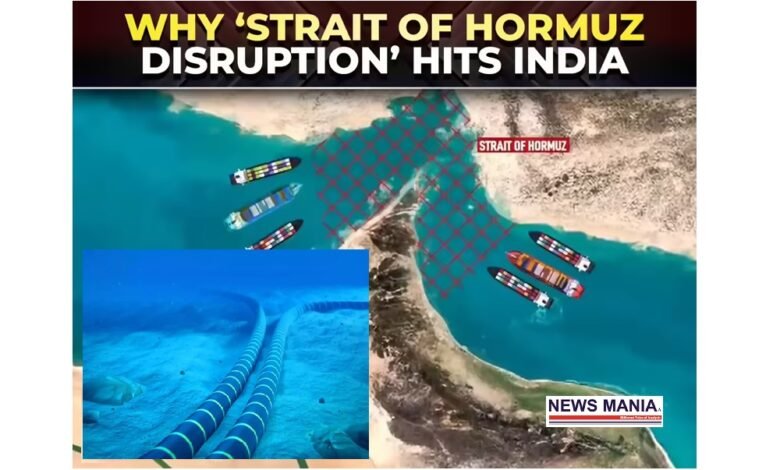
A large portion of the world’s oil exports pass through the Strait of Hormuz, making it one of the most important energy chokepoints in the world. However, the strategic route is also becoming a major hub for the world’s digital infrastructure. Experts caution that a dense network of underwater fiber optic cables, which are essential for India’s worldwide internet connectivity, is located in the same route that transports oil tankers as geopolitical tensions in West Asia rise.
Therefore, any disruption in this area might have an impact not just on the energy markets but also on the digital networks that support India’s internet, cloud services, and international data flows. Satellites do not carry the majority of the world’s internet traffic. Rather, it travels via fiber optic cables that are positioned throughout the ocean floor. Emails, bank transactions, cloud data, video calls, and almost all types of cross-border digital communication are carried by these underwater cables.
These cables that connect Asia with Europe and the Middle East now use the Strait of Hormuz and the surrounding Gulf waters as a major transit route. Due to the convergence of several cable lines in this small area, geopolitical instability may create new hazards for vital digital infrastructure. India’s global internet connectivity depends heavily on submarine cables that run westwards through the Arabian Sea and the Gulf before connecting to Europe and other regions.
This makes the Strait of Hormuz a vital digital gateway for India’s international data traffic. The passage controls about a third of India’s westward internet traffic. That means a significant portion of the country’s cross-border data exchange flows through networks that pass through or near this maritime chokepoint.
These data flows support a wide range of digital services, including cloud computing platforms, international banking and financial networks, global enterprise operations, and social media and streaming services hosted abroad.
Numerous long-distance fiber optic networks connecting Europe, the Middle East, and South Asia are located in the Gulf region. These cable networks connect several landing stations across continents and run thousands of kilometers along the ocean floor. The region is seeing significant investments in new digital infrastructure, according to industry experts.However, if geopolitical tensions rise, the region’s increasing cable concentration also makes it more vulnerable.
Instability in the Strait of Hormuz poses significant risks to undersea cable infrastructure. Physical damage from anchors, accidents, or explosions can disrupt internet traffic, with previous cable cuts near Saudi Arabia indicating a substantial impact on regional connectivity. Repair operations are hindered by the security environment, with ongoing conflicts affecting the deployment of repair ships since September 2025.
Moreover, while internet traffic can theoretically be rerouted, alternative submarine cables often lack the necessary capacity, leading to congestion and degraded performance for users. The region is increasingly recognized as a digital chokepoint, with its vulnerability highlighting broader geopolitical concerns affecting global connectivity. For India’s growing digital economy, ensuring the resilience and diversification of undersea connections is essential amidst these challenges.