
During India’s briefing on Operation Sindoor, two female officers take charge.
News Mania Desk / Piyal Chatterjee / 8th May 2025

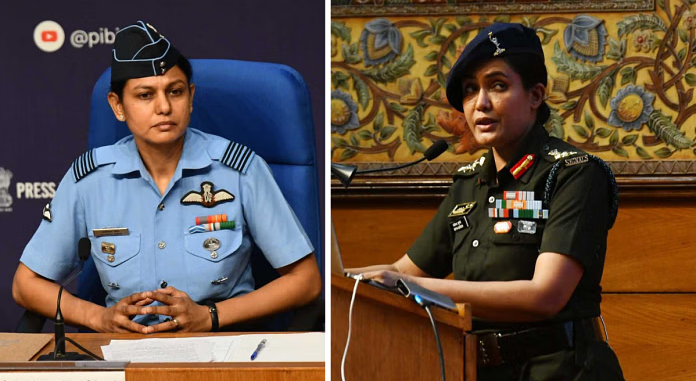
India’s update on ‘Operation Sindoor’ today conveyed a powerful and important message as two female officers – Wing Commander Vyomika Singh and Colonel Sofiya Qureshi – spearheaded the briefing, revealing specifics of the military’s precise strikes on terrorist locations in Pakistan following the April 22 Pahalagam terror attack that claimed 26 lives.
The designation “Operation Sindoor,” honoring the women who lost their spouses in the terror attack, and the selection of women officers to conduct the briefing was commended as a significant action.
“Terror targets were chosen based on credible intelligence and their involvement in cross-border terrorism. No military installation was targeted in Pakistan during ‘Operation Sindoor’,” Colonel Sofiya Qureshi said, speaking after Foreign Secretary Vikram Misri.
She also announced that nine terrorist camps were destroyed.
Wing Commander Vyomika Singh said, “India has demonstrated considerable restraint in its response. However, the India Armed Forces are fully prepared to respond to a Pakistani misadventure, if any, to escalate the situation.”
Wing Commander Vyomika Singh is a notable helicopter aviator in the Indian Air Force (IAF). She became a member of the National Cadet Corps (NCC) and subsequently finished her engineering studies. Wing Commander Singh was granted a permanent commission in the flying branch on December 18, 2019. She has piloted helicopters like the ‘Chetak’ and ‘Cheetah’ in some of India’s toughest terrains, including high-altitude regions such as Jammu and Kashmir and the Northeast.
Wing Commander Singh has been involved in numerous rescue operations.
Colonel Sophia Qureshi is an honored officer of the Indian Army’s Signals Corps. She is the inaugural female officer to command an Indian Army unit in a multinational military drill in Pune – among the largest foreign military exercises ever held on Indian territory.