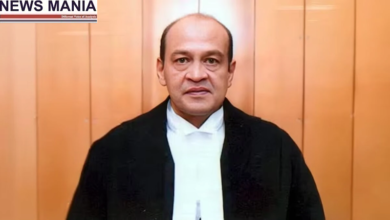
After sterilizing stray dogs, the Supreme Court amends its “harsh” ruling.
News Mania Desk / Piyal Chatterjee / 22nd August 2025


The Supreme Court on Friday modified its contentious August 8 ruling on stray dogs in Delhi-NCR, directing their release to the same region from where they were picked up after vaccination and deworming – a verdict that was welcomed with elation by animal lovers. However, the top court ordered that dogs with aggressive behavior or rabies must be vaccinated and housed in separate shelters.
“Prohibition on release of strays shall be stayed. They should be dewormed, vaccinated and sent back to the same area,” the Supreme Court said, calling its August 8 order “too harsh”. The top court, however, expanded the scope of the case across India, suggesting that it would formulate a national policy.
The August 8 ruling, which instructed local authorities in Delhi-NCR to collect all stray dogs within eight weeks and place them in designated shelters, was modified in a number of ways by the three-judge bench, which was made up of Justices Vikram Nath, Sandeep Mehta, and NV Anjaria. After the Justice Pardiwala-led bench’s decision caused much indignation, the Chief Justice made the unusual decision to reassign the matter to the three-judge bench.
A “catch-22 situation” could result from a general directive to collect all street canines and deposit them in shelters without assessing the current infrastructure, the three-judge panel noted while referencing the earlier ruling.
However, the top court strictly maintained that public feeding of stray dogs would not be permitted and action would be taken against violators. “No public feeding of dogs allowed. Dedicated feeding spaces of stray dogs to be created. Action will be taken against persons found to be feeding dogs on the streets,” the court said.
The court also permitted animal lovers to submit applications for the dogs’ adoption, with the disclaimer that it would be their duty to make sure the strays were not put back on the streets. Additionally, the court ordered the NGOs that approached it and each individual petitioner to deposit Rs 2 lakh and Rs 25,000, respectively.
In order to create a national policy on the matter, the Supreme Court ultimately said that it would take comparable petitions that were pending in other High Courts and transfer them to itself. According to petitioner and attorney Nanita Sharma, the Supreme Court’s ruling places the responsibility for caring for the strays on the government.
“It is a good order which clearly states that dogs need to be released back after sterilisation. The dogs have to be looked after by the authorities. I appeal to the authorities to be a bit more humane,” Sharma told
Since the Justice Pardiwala-led court ordered the city authorities in Delhi-NCR to seize all stray dogs and keep them in shelters, unless they are released back into the streets, the issue has taken center stage in Delhi and generated a lot of conversation on social media.
Within eight weeks, the civic authorities were also instructed to set up shelters that could accommodate at least 5,000 strays. Additionally, the court established welfare protections for dogs housed in shelters. The top court ruled that the directions were required due to a rise in rabies cases and dog bites. 25,000 dog bite instances were reported in Delhi in 2024, with more than 3,000 occurring in January 2025 alone, according to government data.
However, the decision caused a great deal of indignation among NGOs and animal advocates who contended that there were no facilities to house an estimated eight lakh stray canines. Keeping so many animals in shelters, according to the campaigners, would cause logistical problems and encourage animal abuse. One of the main arguments was that the August 8 order violated the Animal Birth Control (ABC) Rules, which provide that vaccinated and sterile stray dogs must be freed from their original location and cannot be permanently transferred.