As the US increases energy pressure, Russia’s crude output declines.
News Mania Desk /Piyal Chatterjee/ 9th February 2026
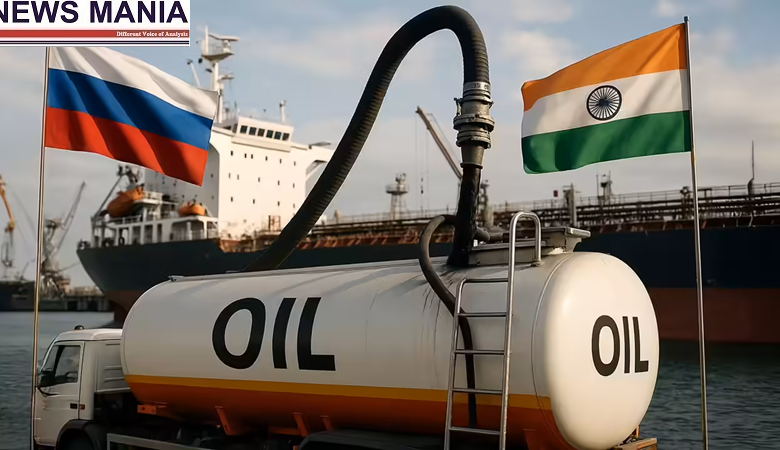
In January, Russia’s crude production fell for the second consecutive month as the third-largest oil producer in the world struggles to sell its barrels due to US sanctions.According to persons with knowledge of the data who asked not to be named in order to share sensitive material, the country produced 9.28 million barrels of crude oil per day on average last month. The amount, excluding condensate output, is 46,000 barrels per day below a December level that had already been lowered and about 300,000 barrels per day below what Russia is permitted to produce under an agreement with the Organization of the Petroleum Exporting Countries and its allies.
Independent evaluations are challenging since Russia has classified its data on refinery operations, exports, and oil output.
The production drop coincides with an increase in the quantity of Russian petroleum stored on tankers, suggesting that certain cargoes are taking a long time to find customers despite mounting pressure from the US on the Kremlin. US President Donald Trump claimed earlier this month that he had removed an additional 25% tax that he had placed on India in return for New Delhi ceasing to buy oil from Russia.
India has acknowledged the trade agreement, but it has not addressed specifics, such as oil. However, since Trump initially brought up the contract in a social media post almost a week ago, almost all Indian refiners, both state-owned and private, have stopped purchasing any spot cargoes.
The total amount of Russian crude on sea had increased to 143 million barrels by the beginning of February, nearly tripling from the previous year and increasing by more than 25% from late November. Some tankers carrying sanctioned barrels are now en route to China, another significant buyer of Russian petroleum, while India has backed out of purchases. However, it’s still uncertain how many more barrels Moscow sells and how much the Chinese market will take in.
The Russian budget, which depended on the oil and gas sector for almost 23% of its income last year, is at risk from declining production. The Russian government’s oil earnings fell to a five-year low in January due to harsher discounts, a stronger currency, and declining world prices. If Russia’s output restrictions persist, the country also runs the risk of losing its market share to OPEC allies. The group has not yet publicly announced its strategy beyond March, and has pledged to maintain output at a constant level in the first quarter of 2026. Alexander Novak, the deputy prime minister of Russia, stated last week that the group anticipates an increase in the demand for oil worldwide beginning in March or April. Given that Russia has recently called for OPEC to exercise caution while boosting barrels, Novak’s remarks are especially significant.