
Astronomers Discover Hidden Companion Star Orbiting Giant Betelgeuse
News Mania Desk / Piyal Chatterjee / 22nd July 2025

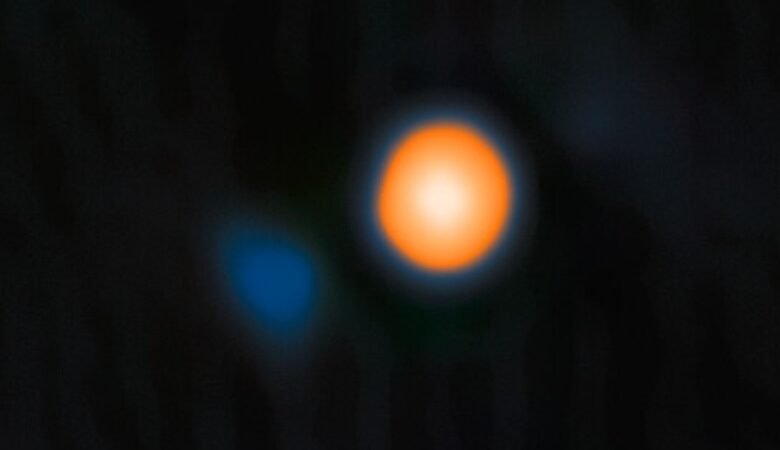
In a major astronomical breakthrough, scientists have identified a previously unseen companion star orbiting Betelgeuse, the massive red supergiant that gleams visibly in the night sky from Earth. This discovery, confirmed using the ‘Alopeke speckle imaging system mounted on the Gemini North telescope in Hawaii, helps unravel long-standing mysteries about Betelgeuse’s erratic brightness variations and sheds light on the dynamics of massive stellar systems.
Betelgeuse, located in the constellation Orion, is among the most prominent stars visible to the naked eye. For decades, scientists have puzzled over its strange behavior—particularly its well-known 400-day pulsation cycle and a longer, unexplained brightness dip every six years. These fluctuations have now been linked to the gravitational influence of a smaller, dimmer companion star that had long eluded detection due to the overwhelming glare of the primary star.
The newfound companion, nicknamed “Betelbuddy” or “Siwarha,” is estimated to be about 1.5 times the mass of our Sun. Unlike Betelgeuse, which is in its dying phase, this smaller star is still in its early pre–main-sequence stage, meaning it hasn’t yet begun stable hydrogen fusion. What makes the discovery especially fascinating is its orbital distance—roughly four times the Earth–Sun separation—which places it within Betelgeuse’s extended atmosphere, an extremely rare configuration for binary star systems.
Advanced imaging tools, capable of cutting through the visual noise caused by Earth’s atmosphere, were essential in revealing the companion. Although the evidence is still at the edge of the instrument’s resolution limits, the data closely matches theoretical models proposed in recent years, including a 2024 paper titled “A Buddy for Betelgeuse.”
This discovery is significant because it not only explains the mysterious brightness shifts observed over decades but also predicts a dramatic future: due to gravitational drag, the companion star is likely to spiral into Betelgeuse and be absorbed in approximately 10,000 years. Such a stellar interaction is rare and could yield even more insights into stellar evolution.
Scientists plan to observe the system again in November 2027, when the two stars will be at their maximum separation, offering an even better opportunity to study this remarkable celestial duo. The revelation marks a new chapter in the study of red supergiants and the powerful forces that shape them.