Balancing the World: India’s Strategic Autonomy in an Era of Global Conflict
Ms.Bornali Biswas-Editor in Chief

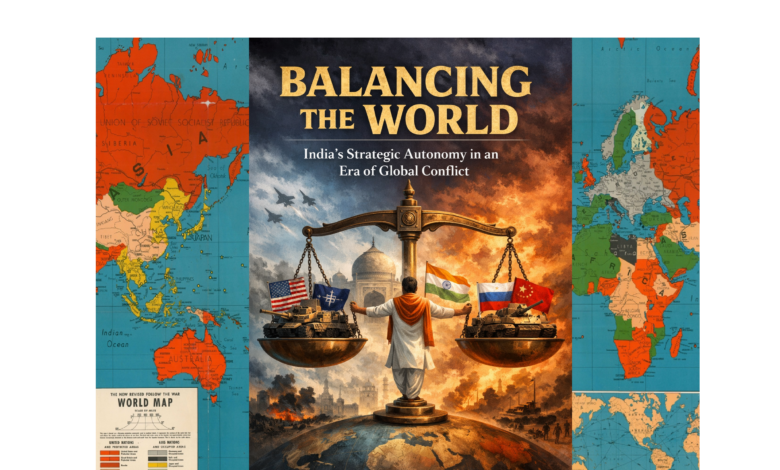
As the world grapples with simultaneous geopolitical crises—from the prolonged Russia-Ukraine War to escalating tensions in West Asia—India finds itself navigating a complex and delicate path. Rather than aligning fully with any one bloc, New Delhi has embraced a doctrine of “strategic autonomy,” a policy that allows it to safeguard national interests while maintaining relationships across competing global powers.
This balancing act is not merely diplomatic posturing; it is a calculated response to a rapidly shifting global order where economic stability, energy security, and geopolitical influence are deeply intertwined.
The Core of Strategic Autonomy
India’s approach is rooted in its historical ties with Russia—a long-standing defense and energy partner—while simultaneously strengthening economic, technological, and strategic relations with Western nations, particularly the United States and European allies. This dual engagement has enabled India to retain flexibility in decision-making, especially during crises where taking sides could carry significant economic and political costs.
On global platforms, India has maintained a neutral stance, often abstaining from key votes while consistently advocating dialogue, diplomacy, and peaceful resolution. This neutrality, however, is not passive—it is an active effort to position India as a stabilizing force in a polarized world.
Economic Strain and Domestic Impact
The consequences of these global conflicts are being felt acutely within India’s economy. Disruptions in supply chains have driven up the cost of essential imports, including fuel, fertilizers, and edible oils such as sunflower oil—much of which traditionally comes from Ukraine.
Rising fuel prices remain a central concern. Although India has managed to avoid a physical shortage of oil and gas, the risk lies in price volatility. By increasing imports of discounted Russian crude—now accounting for a significant share of total imports—India has managed to cushion the blow. Without such measures, petrol prices could have surged by ₹5–7 per litre, intensifying inflationary pressures.
At the same time, global spikes in liquefied natural gas (LNG) prices have increased costs for industries and households, adding to the broader economic strain. Fertilizer prices, critical for India’s agrarian economy, have also been affected, raising concerns ahead of key agricultural cycles.
Trade and Diplomatic Pressures
India’s neutral stance has not come without challenges. Western nations have repeatedly urged New Delhi to take a firmer position against Russia, placing diplomatic pressure on the government. Additionally, sanctions and shifting trade dynamics have complicated export-import relationships.
Trade routes, particularly those passing through strategic chokepoints like the Strait of Hormuz, face heightened risks amid West Asian tensions. Any disruption here could have cascading effects on shipping costs, insurance premiums, and delivery timelines. Furthermore, continued trade with Russia has exposed India to the possibility of secondary tariffs, especially from Western markets.
Humanitarian and Security Concerns
Beyond economics, the human cost of these conflicts is a pressing concern for India. Millions of Indian expatriates reside in the Gulf region, making their safety a top priority amid rising instability. The government has also been actively addressing cases of Indian nationals caught in conflict zones, including those entangled in trafficking networks linked to the Russia-Ukraine war.
India’s track record as a humanitarian responder has been notable. It has provided aid to Ukraine and carried out large-scale evacuation missions, reinforcing its commitment to protecting citizens and supporting global relief efforts.
India as a Global Bridge
In a deeply divided international landscape, India occupies a unique position. Its ability to maintain open communication channels with both Moscow and Washington positions it as a potential mediator in global conflicts. While not formally stepping into that role, India’s diplomatic posture has earned it credibility as a voice of reason.
Moreover, India has emerged as an alternative supplier in disrupted global markets. From pharmaceuticals to refined petroleum products and agricultural goods, Indian exports are helping fill gaps created by war-driven supply shortages. This not only boosts India’s economic standing but also strengthens its strategic relevance.
As a leading voice of the Global South, India has consistently highlighted how developing nations bear the brunt of these conflicts—through food insecurity, energy shortages, and economic instability. Platforms like the G20 have been instrumental in amplifying this perspective.
Securing the Energy Future
India’s energy strategy reflects a pragmatic approach to uncertainty. By diversifying its sources—ranging from Russian crude to imports from the United States and traditional Middle Eastern suppliers—India is building resilience against supply shocks.
As of March 2026, the government has assured that supplies of petrol, diesel, and gas remain stable, backed by strategic coordination and diversified sourcing. The emphasis is clear: prevent shortages while managing price volatility.
Conclusion
India’s response to ongoing global conflicts underscores a broader shift in its foreign policy—from reactive to strategic, from alignment to autonomy. In a world increasingly defined by rivalry and fragmentation, India’s ability to balance relationships, protect its economic interests, and contribute to global stability will be crucial.
The path of strategic autonomy is not without risks, but it offers India the flexibility to navigate uncertainty while shaping its role as a key player in the emerging global order.