Centre Tells Supreme Court India Cannot Be Viewed Through Western Lens in Sabarimala Case
News Mania Desk/ Piyal Chatterjee/7th April 2026

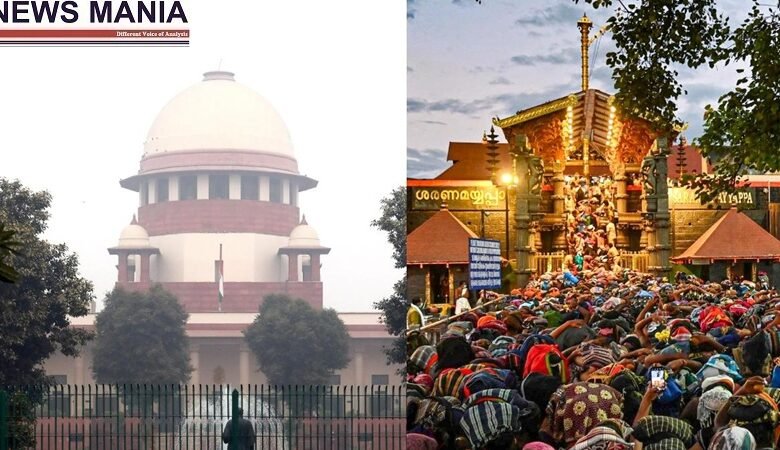
The Centre on Tuesday told the Supreme Court of India that Indian society should not be interpreted through Western frameworks of patriarchy and gender stereotypes, as hearings continued in the long-running Sabarimala reference case. Appearing before a nine-judge Constitution Bench, Solicitor General Tushar Mehta argued that India has a distinct cultural and civilisational ethos where women have historically been accorded respect and dignity. He submitted that labeling Indian society as patriarchal in the same sense as understood in the West would be inaccurate and overly simplistic.
The submissions were part of the Centre’s broader arguments in the Sabarimala case, where key constitutional questions related to the intersection of religious freedom and fundamental rights are being examined. The Bench is revisiting issues arising from the 2018 judgment that had allowed entry of women of all age groups into the Sabarimala temple in Kerala.
The Centre also opposed the application of Article 17 of the Constitution, which abolishes untouchability, to gender-based restrictions in religious practices. Mehta contended that equating temple entry restrictions with untouchability was legally flawed and inconsistent with India’s constitutional scheme. He emphasised that such restrictions, in the context of Sabarimala, were not based on discrimination but on the specific nature and traditions associated with the deity worshipped at the temple.
Further, the Solicitor General highlighted that the restriction in question applied only to women of a particular age group and did not amount to a blanket exclusion of all women. According to him, this distinction is crucial in understanding the religious practice and should not be conflated with systemic discrimination.
During the hearing, references were also made to the role of women in shaping India’s constitutional framework. Mehta pointed out that several prominent women members of the Constituent Assembly played a key role in ensuring that constitutional provisions struck a balance between reform and respect for religious traditions.
Justice B. V. Nagarathna, who is part of the Bench, observed that the contributions of women in the Constituent Assembly deserved greater recognition, even suggesting that they be regarded as the “founding mothers” of the Constitution.
The Centre further argued that the phrase “all persons are equally entitled” under Article 25 was intended to preserve religious harmony and equality across faiths, rather than specifically address gender-based entry into places of worship. As the hearings continue, the Supreme Court is expected to deliberate on the complex balance between individual rights and religious freedoms, a question that remains central to the Sabarimala dispute and its wider constitutional implications.