Chemistry Nobel Prize awarded to trio in field of metal organic frameworks
News Mania Desk / Piyal Chatterjee / 8th October 2025

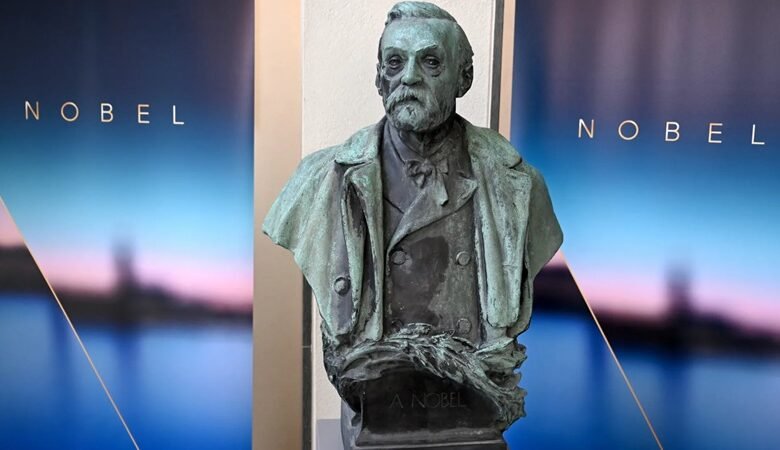
For their contributions to the creation of metal organic frameworks (MOF), Susumu Kitagawa, Richard Robson, and Omar M. Yaghi have been granted the 2025 Nobel Prize in Chemistry by the Royal Swedish Academy of Sciences.
The three scientists who received the honor on Wednesday are from the American university of Berkeley, the Australian university of Melbourne, and the Japanese university of Kyoto. According to a Nobel Prize statement, the three have produced “molecular constructions with large spaces through which gases and other chemicals can flow.” These structures can be utilized to store harmful gasses, absorb carbon dioxide, extract water from desert air, or degrade environmental pharmaceutical traces.
“Metal organic frameworks have enormous potential, bringing previously unforeseen opportunities for custom-made materials with new functions,” said Heiner Linke, chair of the Nobel Committee for Chemistry.
Nobel Committee for Chemistry member Olof Ramstrom said the new type of molecular architecture is like Hermione Granger’s handbag from the Harry Potter series: it’s modest on the exterior but enormous on the inside.
Working independently while building on each other’s discoveries, the chemists developed methods for creating stable metal organic frameworks that are comparable to a house’s timber framework.
These structures have numerous real-world uses today, such sucking water out of dry desert air or absorbing carbon dioxide from the atmosphere. They can also collect and hold gasses inside their frameworks.
In 1989, Robson combined positively charged copper ions with a four-armed molecule to investigate the characteristics of atoms in a novel method, marking the beginning of what would have been a decades-long quest. According to the Nobel Prize announcement, this had a chemical group at the end of each arm that was drawn to copper ions.
Together, they created a structure like a diamond with voids. However, the crystal would readily crumble. At that point, Kitagawa and Yaghi came into view. Between 1992 and 2003, they worked independently and discovered a number of ways to stabilize the metal frames. While Kitagawa demonstrated that they could be made flexible, Yaghi found that rational design could be used to modify them.
On Monday, the first 2025 Nobel laureate was revealed. Mary E. Brunkow, Fred Ramsdell, and Dr. Shimon Sakaguchi were awarded the medical prize for their research on peripheral immunological tolerance.
For their work on the strange realm of subatomic quantum tunneling, which enhances the capabilities of commonplace digital communications and computing, John Clarke, Michel H. Devoret, and John M. Martinis were awarded Tuesday’s physics prize.