Delhi hogs the attention after Diwali, but air in these cities is just as toxic
News Mania Desk / Piyal Chatterjee / 22nd October 2025

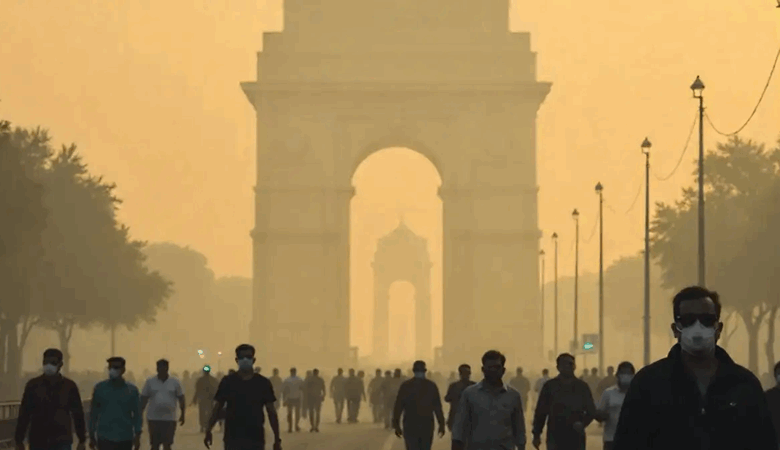
Delhi’s air quality consistently draws notice after Diwali. This year was no exception, as the national capital’s almost 2 crore residents awoke to the most filthy air of any large city in the world on Tuesday, igniting a heated discussion. When it comes to other major cities like Kolkata or Mumbai, where the air was just as poisonous before and after Diwali, the same feeling of urgency or focus is lacking.
Year after year, the same narrative is repeated, with pollution being viewed as a problem specific to Delhi-NCR rather than as a national emergency. Despite this, Delhi’s air quality index (AQI) fell into the “very poor” category on Tuesday, marking the worst post-Diwali air quality in the previous four years. On Wednesday, there was no noticeable change either. However, according to data from the Swiss air quality company IQAir, two other cities, including Delhi, were listed among the top 10 most polluted cities in the world.
Mumbai and Kolkata came in fifth and eighth place, respectively, despite recent alarming increases in air pollution. This information hardly garnered media attention, avoiding the public eye and social media criticism. Following Diwali, Mumbai—a city renowned for its closeness to the sea and comparatively better air—saw one of its worst polluted days of the year, with multiple areas falling into the “very poor” category.
Nowadays, the post-Diwali spike is a yearly worry.On Tuesday morning, Bandra Kurla Complex had the worst AQI, at 375, followed by Colaba (346), and Mazgaon (309). Worli and Byculla were among the ten or more regions with poor AQI readings above 200.
An AQI between 0 and 50 is considered “good”, 51 to 100 “satisfactory”, 101 to 200 “moderate”, 201 to 300 “poor”, 301 to 400 “very poor”, and 401 to 500 “severe”.
The widespread usage of firecrackers, along with low wind speeds and high humidity, has been mostly blamed for the increase in pollution. These factors have kept pollutants near the ground.
Actually, throughout the last two weeks, Mumbai’s air quality has declined, with the AQI lingering around the “moderate” to “poor” range.
On Wednesday, however, Mumbai residents breathed fresher air thanks to overnight rain, as the AQI improved to the “poor” level. The respite might not last long, though, as experts have warned that La Nina, a phenomenon that alters coastal breezes, might cause the air quality to degrade even more. La Nina causes wind speeds to drop, which slows the spread of pollutants. The air may contain pollutants for a longer period of time if La Nina develops.
Kolkata fared worse, with a poisonous cloud enveloping the “City of Joy” as partygoers let off firecrackers for longer than the two-hour allowed (8–10 pm). Areas such as Howrah had “very poor” air quality, with an AQI of 364—higher than Delhi.
According to the PTI, the AQI read 361 at Padmapukur and 252 at Ghusuri. The city’s total air quality, however, continued to fall into the “poor” range.
Delhi suffers from pollution all year round, particularly in the winter when farmers in neighboring states burn stubble in their fields to plant new crops. But in recent years, other major cities have also been listed as some of the most polluted in the world.
Instead of concentrating only on Delhi, it is imperative that pollution be treated as a national health concern.