Earth to be hit again after solar storm causes radio blackout over Europe, Africa
News Mania Desk/Piyal Chatterjee/12th November 2025

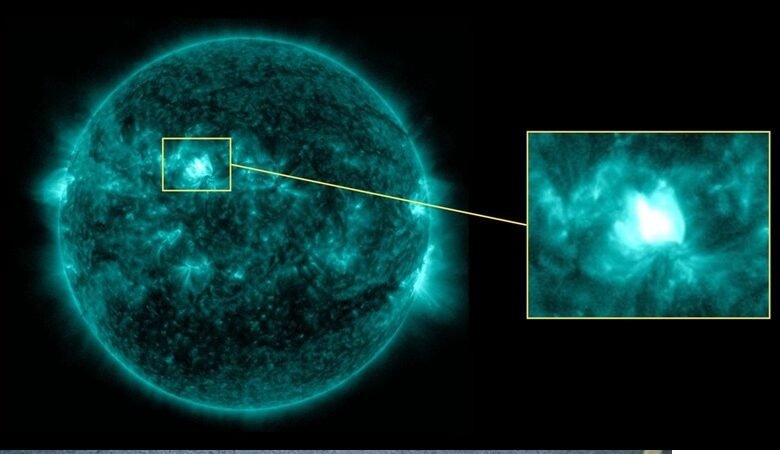
On November 11, the Sun erupted its greatest solar flare of 2025, sending shockwaves across Earth’s atmosphere and interfering with international communications.
At 5 a.m. EST (10:00 GMT), the X5.1-class flare—the biggest solar outburst since October 2024—erupted from the extremely active sunspot AR4274.
High-frequency radio communications over Africa and Europe on the sunlit side of the planet were significantly impacted by this large burst, which caused a catastrophic (R3-level) radio blackout. This flare is part of a recent string of strong eruptions from AR4274 that produced coronal mass ejections (CMEs) that are predicted to interact with Earth’s magnetic field, including an X1.7-class flare on November 9 and an X1.2 flare on November 10.
Researchers are keeping a careful eye on whether the most recent X5.1 flare sent a CME straight for Earth. Any related CME that is oriented toward Earth is likely to affect our planet, possibly combining with earlier CMEs to create a so-called “Cannibal CME.”
Geomagnetic storms are intensified when two CME clouds collide and magnify each other’s impacts. Forecasters predict that two CMEs will strike Earth’s magnetosphere on November 12 and may merge shortly before they do. Strong G3-class geomagnetic storms, which are known to interrupt satellite operations, electrical networks, and produce breathtaking auroral displays well beyond typical polar regions, could be triggered by this.
Interestingly, a similar occurrence in April 2025 resulted in a powerful G4-class geomagnetic storm that illuminated skies as far south as France.
Although the “Cannibal CME” scenario would intensify space weather disruptions, models also permit the CMEs to merge outside of Earth’s orbit, which would still produce a notable but milder geomagnetic storm. In any case, radio providers, power grid management, and satellite operators are watching for possible effects.
This solar activity, which is marked by increasing sunspot activity and solar eruptions, takes place close to the top of Solar Cycle 25. The requirement for constant observation and readiness to lessen impacts on contemporary technology infrastructure is highlighted by the dynamic space weather environment.
During the nights after the CME impacts, skywatchers should keep an eye out for bright auroras, which provide a stunning natural show brought on by the Sun’s strong magnetic disruptions.